Just Say No to Dyed Mulch — And Please Stop Making Mulch Volcanoes
Todd & Sabrina | Garden Guy
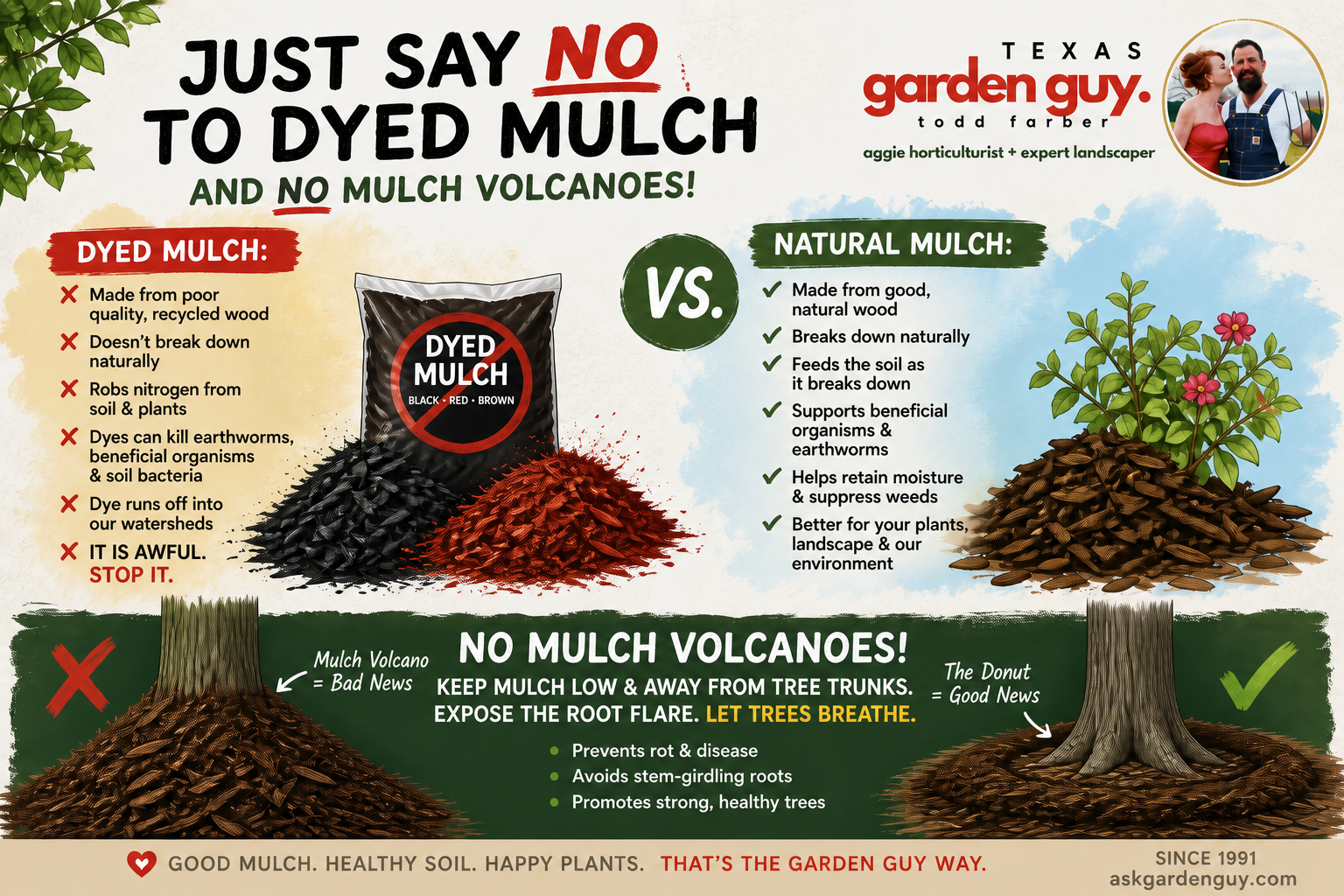
Dyed mulch and mulch volcanoes can damage your landscaping, stress your plants, and harm trees over time. Garden Guy explains what to use instead in Houston and Sugar Land landscapes.
Just Say No to Dyed Mulch
A horticulturist’s rant about dyed mulch, tired plants, and those awful mulch volcanoes.
If you have followed Garden Guy for any length of time, you already know Todd has strong feelings about dyed mulch.
Black dyed mulch. Red dyed mulch. That rubbery-looking, painted-looking, unnatural mulch that gets piled around shrubs, trees, and flower beds all over Houston and Sugar Land.
Todd’s answer is simple:
Please don’t use it.
We know it looks tidy for a little while. We know some homeowners like the dark “finished” look. We also know some HOAs have made black mulch popular because it looks uniform from the street.
But as a horticulturist who has been designing and installing Houston landscapes for more than 30 years, Todd does not recommend dyed mulch as the best choice for healthy plants, healthy soil, or long-term landscape success.
And while we are talking about mulch sins, let’s add the other big one:
No mulch volcanoes.
If the mulch is piled up around the trunk of a tree like a little mountain, that is not professional. That is a problem waiting to happen.
Key Takeaways from Garden Guy
Dyed mulch is usually chosen for appearance, not plant health.
The biggest concern is often the wood source, not just the dye.
Many dyed mulches are made from recycled or reprocessed wood products, which can sometimes include questionable material.
Dyed mulch does not improve the soil the same way a good natural shredded hardwood mulch can.
Fresh wood products can temporarily tie up nitrogen as they break down, especially when mixed into the soil or used heavily around small plants.
Mulch should never touch the trunk of a tree or be piled up like a volcano.
A good mulch job looks like a donut, not a volcano.
Natural shredded hardwood mulch is still our preferred choice for Houston and Sugar Land landscapes.
What Todd Says When Homeowners Ask for Dyed Mulch
When our clients ask for black or red dyed mulch, Todd strongly advises against it.
If a client insists, we respect their wishes. But we do not recommend it.
Many people simply do not know what dyed mulch is often made from, how it behaves in the landscape, or why it can be a poor choice around living plants.
Once Todd explains it, most clients are surprised and decide they want nothing to do with it.
And for the record, we love those clients.
They are not “bad gardeners.” They just did not know.
That is why we talk about this.
The Real Problem with Dyed Mulch
Here is where we want to be fair and accurate.
Some university extension sources say the dyes used in colored mulch are not necessarily proven toxic to plants by themselves. The University of Maine notes that there is no evidence that mulch dyes themselves are toxic to plants, but also says homeowners should know the supplier and wood source, especially avoiding recycled wood that may include pressure-treated material.
That is an important distinction.
The issue is not always simply “the dye.”
The issue is the whole dyed mulch category.
UMass Extension explains that some recycled waste wood used in landscape mulch products has been found contaminated with chemicals such as creosote and CCA, which stands for chromated copper arsenate. They specifically note that construction and demolition waste wood can be a red flag when used as a mulch source.
The Mulch & Soil Council also says recycled or reprocessed wood mulch can come from post-consumer or industrial products and may contain construction and demolition material; their standards prohibit CCA-treated material in certified products.
So here is Garden Guy’s plain-English version:
If I have a choice between natural shredded hardwood mulch and a dyed mulch made from unknown recycled wood, I am choosing the natural mulch every time.
Why Natural Mulch Is Better for Your Landscape
Good mulch is not just decoration.
Mulch should help your plants.
A good natural mulch helps regulate soil moisture, suppress weeds, moderate soil temperature, and build organic matter as it breaks down. The organic mulches contribute to soil organic matter, support soil microbes, and improve water-holding capacity as they decompose.
That is what we want in Houston landscapes.
We want mulch that becomes part of the bed over time.
We want mulch that supports the soil.
We want mulch that protects plant roots from heat, drought stress, and moisture swings.
We do not want mulch that just sits there looking artificially black for a few weeks and then fades, crusts, washes, or piles up into a hard layer.
What About Nitrogen?
This is one of the things homeowners do not always see at first.
Wood is carbon. As wood breaks down, soil organisms use nitrogen in that process.
That does not mean every wood mulch is evil. Natural shredded hardwood mulch is still one of our favorite choices. But it does mean poor-quality wood mulch, fresh wood products, or mulch mixed into the soil can create nitrogen competition around plants.
The wood chips and sawdust can deplete soil nitrogen if worked into the soil, and homeowners should watch for chlorotic foliage and slowed growth.
That is why Todd does not want cheap dyed mulch buried into a planting bed or piled heavily around small shrubs, perennials, and annuals.
Your plants should not have to fight the mulch for nutrition.
Mulch should help the bed.
It should not compete with the bed.
Randy Lemmon Agreed
The late Randy Lemmon, Houston’s beloved GardenLine host, was also strongly against dyed mulch.
He warned that dyed mulches do not break down like native or shredded mulches and that many are made from recycled waste wood. He also pointed to possible CCA contamination, nitrogen tie-up, and damage to soil life as reasons to avoid them.
Todd agreed with Randy on this.
In our opinion, Houston landscapes are better served with natural shredded hardwood mulch, native mulch, or a good composted mulch product from a trusted source.
Now Let’s Talk About Mulch Volcanoes
This one makes Todd just as crazy.
A mulch volcano is when mulch is piled high against the trunk of a tree or the base of a shrub.
You have seen it.
A tree trunk comes out of the ground, and instead of seeing the natural root flare, there is a mountain of mulch stacked around it like a cone.
It may look “finished” to some people.
But it is not good horticulture.
It is not good tree care.
And over time, it can seriously damage the tree.
Why Mulch Volcanoes Are So Bad
Tree bark is not supposed to stay wet.
When mulch is piled against the trunk, it holds moisture against the bark. That can soften the bark and invite decay, insects, disease, rodents, and fungal problems.
Volcano mulch buries the root flare, encourages disease and decay because the bark stays wet, interferes with good root development, and can make trees more prone to windthrow.
Mulch piled against trunks can keep bark too moist, making it more susceptible to decay. They also point out that roots may grow into the mulch layer and eventually become stem-girdling roots.
That means the roots can start circling the tree instead of growing outward.
Over time, those circling roots can choke the tree.
This is not instant damage.
That is why people keep doing it.
The tree may look fine for a while.
But years later, the decline shows up.
Mulch Volcanoes Can Cause:
Rotting bark
Disease problems
Insect issues
Rodent damage
Shallow roots
Stem-girdling roots
Poor root flare development
Tree instability
Slow decline over time
Premature tree death
Mulch piled high around trees holds moisture against the bark and invites rot, pests, rodents, and disease.
Garden Guy recommends a 2–3 inch mulch layer that slopes away from the tree, with a clear gap between the stem and the mulch ring.
That is the look we want.
Not a volcano.
A donut.
The Garden Guy Mulch Rule
Here is the simple version:
Mulch should be wide, not tall.
Around trees, you want a wide mulch ring that protects the root zone.
You do not want mulch stacked against the trunk.
The root flare should be visible.
The trunk should be able to breathe.
The mulch should never touch the bark.
How to Mulch the Right Way
Use natural shredded hardwood mulch or another trusted organic mulch.
Remove weeds first.
Do not keep adding new mulch on top of old mulch without checking the depth.
If the old mulch is already too thick, rake it out or thin it before refreshing.
Apply mulch in a shallow, even layer.
Keep mulch several inches away from tree trunks and plant stems.
For trees, leave the root flare exposed.
Spread mulch outward like a donut.
Never pile it up like a volcano.
For most landscape beds, 2–3 inches of mulch is plenty.
For trees and shrubs, many extension sources recommend keeping mulch shallow and away from the trunk or stem. - 1–3 inches and keeping mulch about 3 inches away from tree trunks.
Houston Homeowner Tip
In Houston, Sugar Land, Missouri City, Katy, and the Gulf Coast, we already fight heat, humidity, heavy rain, drainage issues, fungal pressure, and stressed roots.
So why make things harder?
Do not trap moisture against tree bark.
Do not bury the root flare.
Do not pile up mulch year after year until your beds are suffocating.
Do not choose mulch only because it looks dark from the curb.
Choose mulch because it helps the plants.
What Mulch Does Garden Guy Recommend?
Todd generally prefers natural shredded hardwood mulch.
It looks natural.
It breaks down better.
It supports the soil.
It does not give the landscape that artificial painted look.
It works well in the kinds of landscapes we design and install across Houston and Sugar Land.
A good mulch should quietly support the health of the bed.
It should not steal the show.
And it definitely should not become a volcano.
What If My HOA Requires Black Mulch?
We understand this happens.
Some HOAs care more about the curbside “look” than the horticulture.
If you are stuck with an HOA requirement, our practical compromise is this:
Use the least amount possible where it is required for visibility, and avoid piling it around trunks, shrubs, or plant crowns.
If you can use natural shredded hardwood mulch in the less visible areas of the bed, do that.
And no matter what kind of mulch you use:
Do not make mulch volcanoes.
Even natural mulch becomes a problem when it is piled against trunks and stems.
Garden Guy’s Final Word
Mulch is supposed to help your landscape.
It should conserve moisture.
It should protect roots.
It should reduce weeds.
It should slowly improve the soil.
It should make your plants healthier over time.
Dyed mulch is usually chosen for looks, not plant health.
Mulch volcanoes are usually created for speed, not proper horticulture.
Garden Guy says no to both.
Use natural mulch.
Keep it shallow.
Pull it away from trunks and stems.
Let the root flare show.
And if someone tries to sell you a big pile of black dyed mulch stacked around every tree like a little volcano, just remember:
That is not good landscaping. That is a slow-motion plant problem.
Need Help with Your Houston Landscape?
Garden Guy has been designing and installing residential landscapes in Houston, Sugar Land, Missouri City, and surrounding areas for more than 30 years.
Todd Farber is a Texas A&M horticulture graduate and experienced Houston landscape designer who knows what works in real Gulf Coast yards.
If you need help choosing the right plants, fixing tired beds, or planning a full landscape refresh, visit:
Or follow along on Facebook for real Houston landscaping advice from a real horticulturist working in real Houston dirt.
