Houston Lawn Fertilizer Schedule & Pre-Emergent Guide
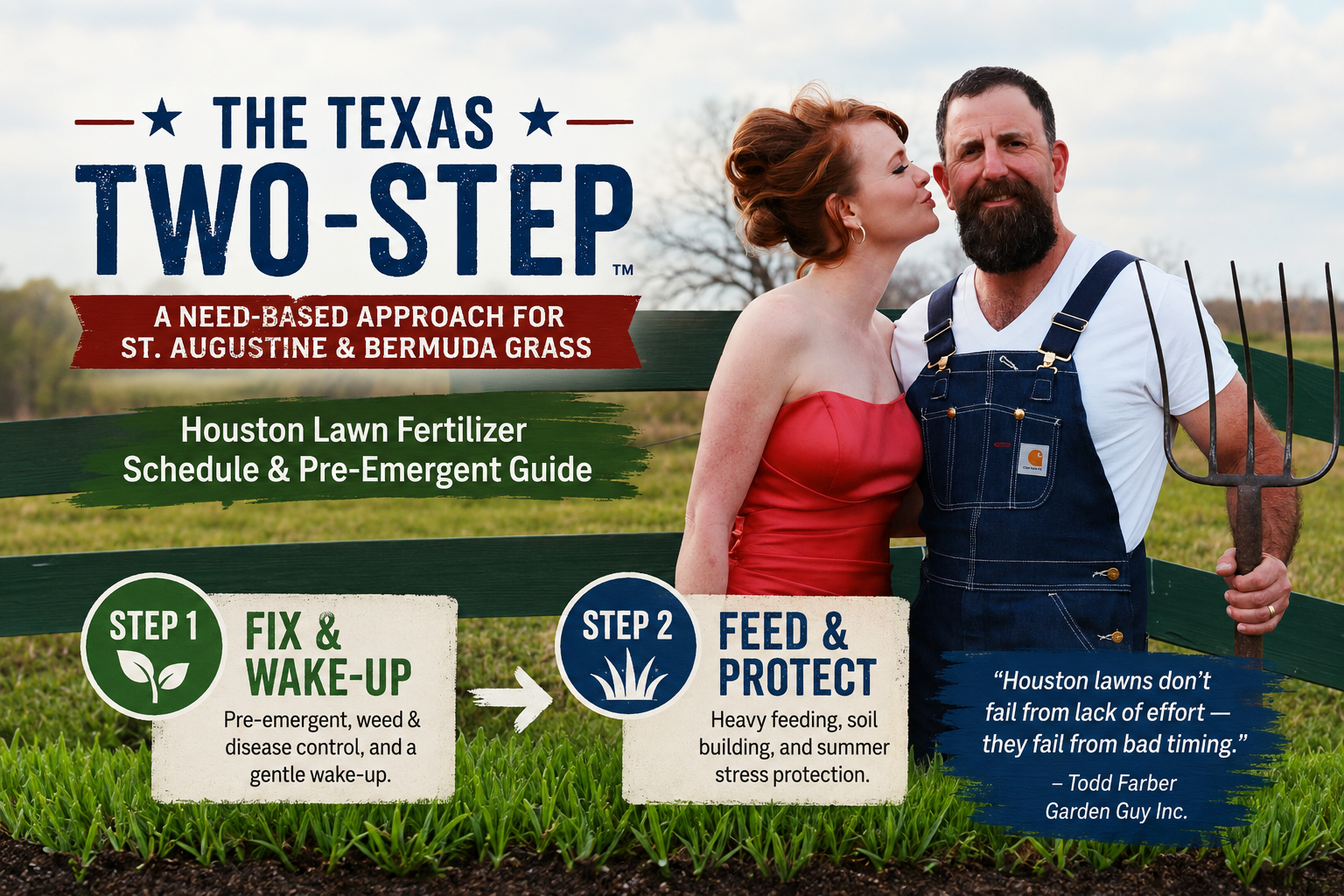
The Texas Two-Step™ Method: A Need-Based Approach for St. Augustine & Bermuda Grass from Garden Guy
Every spring, thousands of Houston homeowners search for a lawn fertilizer schedule — and most end up following advice designed around product sales cycles, not their lawn's actual needs. If you've been listening to Gardenline or following a generic fertilizer calendar, you may be doing things in the wrong order without even knowing it.
My name is Todd Farber. I'm a Texas A&M horticulturist who's been walking Houston-area lawns since 1991. I don't sell fertilizer. I don't take sponsorships. And I've spent 33+ years watching what actually works in our clay soil, our humid summers, and our unpredictable winters.
What I've found: timing and order matter more than which bag of fertilizer you buy. That's the core of the Texas Two-Step™ — and it's what most Houston lawn calendars get wrong.
A New Take — Not a Replacement
If you've been following Randy Lemmon's Gardenline schedule for years and your lawn looks great — keep doing it. Randy Lemmon was a Houston lawn institution, and his program helped more Houston homeowners than most people realize. His passing left a real hole in the Houston lawn care community, and his legacy of practical, local advice is something I genuinely respect.
This isn't a critique of that approach. It's just a different one.
The Texas Two-Step™ is need-based rather than calendar-based. Houston's weather varies enough year to year that a fixed "fertilize on March 1st" date can be six weeks too early in a cold spring — meaning you're pushing a dormant lawn and wasting product. The Two-Step watches what your grass is actually doing and feeds it when it's ready.
Use whatever works for your lawn. We just want you to have another perspective in your toolbox.
"Houston lawns don't fail from lack of effort — they fail from bad timing. Most people were taught to skip a step."
— Todd Farber, Garden Guy
The Texas Two-Step™: Two Phases, One Healthier Lawn
Think of it like the Texas Two-Step dance: two moves, the order matters, and rushing the second step causes problems.
Step 1: Fix & Wake-Up
Correct problems and bring the lawn out of stress — gently. This means pre-emergent weed control, addressing any existing weeds or disease, and a light optional feeding only if the grass is just beginning to show green. No aggressive pushing at this stage.
Step 2: Feed & Protect
Once your lawn has actually earned it — nighttime temps above 55°F for 5+ consecutive days, grass is actively growing and greening — then you feed heavily, build soil strength, and protect against summer stress.
Key rule: Step 2 only works when Step 1 is done. Feeding a lawn that still has weeds just makes the weeds thicker. Feeding a lawn that isn't actively growing is money down the drain.
Houston Clay Soil: Why It Changes Everything
Most lawn advice is written for somewhere else. Houston's heavy black clay soil is a different animal entirely — and it's the reason generic fertilizer schedules often underperform here even when followed perfectly.
It holds water longer. Overwatering on clay is the #1 cause of fungal disease we see — brown patch, gray leaf spot, take-all root rot. What feels like a normal watering schedule somewhere else can be way too much here.
It compacts easily. Compacted clay cuts off oxygen to roots, stressing the grass and making it more vulnerable to chinch bugs, disease, and drought even when it's being watered.
It runs alkaline. Houston's soil pH is often too high for grass to absorb iron efficiently — which is why so many lawns stay yellow even after fertilizing. If you're feeding and still seeing yellow, iron deficiency from alkaline clay is usually the culprit.
It warms slowly in spring. Clay takes longer to warm than sandy soil, which means your grass may wake up later than a neighbor a few counties over — another reason to watch conditions rather than the calendar.
Todd has been working Sugar Land, Missouri City, Katy, Pearland, and Friendswood clay for 33 years. It responds beautifully when you work with it instead of against it.
Know What You're Actually Working With: Get a Soil Test
If you've been fertilizing faithfully and your lawn still isn't responding the way it should, the answer is almost always in the soil — not the product. A soil test tells you your exact pH, nutrient levels, and what's actually missing before you spend another dollar on product. Texas A&M offers an affordable, reliable soil test that gives you results you can actually use.
👉 Submit a Texas A&M Soil Test →
Build Better Soil Over Time
Products fix symptoms. Better soil fixes the lawn. Organic matter, compost, and the right soil amendments rebuild Houston clay from the ground up — improving drainage, reducing compaction, and making every fertilizer application more effective. We put together a full guide on exactly how to do it.
👉 Read our Improve Your Soil Guide →
👉 Browse soil amendments and conditioners on Amazon →
Pre-Emergent Herbicides for Houston Lawns: The Most Important Step Nobody Gets Right
If there's one thing I wish every Houston homeowner understood, it's this: pre-emergent herbicide is not optional, and timing is everything. This is the single highest-leverage move you can make for your lawn — and the one most people miss or mistime.
What Is a Pre-Emergent Herbicide?
A pre-emergent doesn't kill existing weeds. It creates a chemical barrier in the soil that prevents weed seeds from germinating. Applied correctly, it stops crabgrass, goosegrass, spurge, henbit, and chickweed before they ever become a problem. Miss the window, and you're spending all summer spraying post-emergents and losing.
When to Apply Pre-Emergent in Houston
The deadline is February 1st. That's when soil temperatures in the Houston area begin approaching 55°F consistently — the trigger point at which most warm-season weed seeds germinate. Once the soil hits 55°F, pre-emergent becomes ineffective for that season's weed pressure.
Target date: Apply by February 1st
Soil temp trigger: 55°F consistently = weed seeds are germinating
What it prevents: Crabgrass, goosegrass, spurge, sandburs, henbit, chickweed
Safe for: Both St. Augustine and Bermuda grass
Take the Guesswork Out: Use a Soil Thermometer
You don't have to guess when your soil hits 55°F. A simple soil thermometer pushed 2–3 inches into the ground gives you an exact reading in seconds. Todd uses one regularly — it's the most honest tool in lawn care because your soil doesn't care what month it is. Push it in at the same spot every few days in January and you'll know exactly when your pre-emergent window is closing.
👉 Get the soil thermometer Todd uses →
Don't wait for the grass to green up before applying. Bermuda lawns especially — your grass may still look brown and dormant when February 1st hits. Apply anyway. The pre-emergent is targeting weed seeds in the soil, not your grass.
Which Pre-Emergent to Use
I recommend Barricade Professional-Grade Granular Pre-Emergent (active ingredient: Prodiamine). This is the same chemistry professionals use. One 50 lb bag covers 12,500 sq ft.
Apply at 4 lbs per 1,000 sq ft with a broadcast spreader
Water in within 24 hours (¼ to ½ inch) — or apply right before rain
Lasts 3–6 months with proper application
👉 Browse fertilizer and lawn treatment options on Amazon →
Already Have Weeds? You Need Post-Emergent Too
Pre-emergent only stops seeds from germinating — it won't touch weeds already growing. If you're seeing broadleaf weeds, you need a post-emergent approach. The right choice depends on your grass type and the temperature:
For St. Augustine:
Celsius WG + Non-Ionic Surfactant — preferred for warm weather (65–85°F). Broad-spectrum control, safest for St. Augustine as temps rise.
Southern Ag Amine 2,4-D + Surfactant — for cooler weather only (below 85°F). Effective on broadleaf weeds. Always spot spray — never blanket the lawn.
For Bermuda:
Southern Ag Amine 2,4-D is safe for Bermuda. Always add a surfactant and spot spray only.
Garden Guy Rule: Always add a non-ionic surfactant to your post-emergent spray. It's a soap-based additive that helps the herbicide stick to the weed leaf and actually penetrate the plant. Without it, a lot of your spray just runs off.
Not sure what weed you're dealing with? Use our free Texas Lawn Weed Identification Guide →
My name is Todd Farber. I'm a Texas A&M horticulturist who's been walking Houston-area lawns since 1991. I don't sell fertilizer. I don't take sponsorships. And I've spent 33+ years watching what actually works in our clay soil, our humid summers, and our unpredictable winters.
What I've found: timing and order matter more than which bag of fertilizer you buy. That's the core of the Texas Two-Step™ — and it's what most Houston lawn calendars get wrong.
St. Augustine Fertilizer Schedule — Houston Area
St. Augustine is the most common grass in Houston, and it's also the most over-fertilized and worst-timed grass in Houston. Here's the Texas Two-Step™ schedule, tied to what your lawn is actually doing.
Step 1: The "Coffee" Application — Optional, and Only If You See It
If your grass is starting to show some green but isn't fully awake, you can apply a light feeding with Nitro-Phos Imperial 15-5-10. Think of this as coffee, not a meal — a gentle nudge, not a push. In Houston this might happen in February, or it might happen in April. You're watching the grass, not the calendar.
Rate: 5–7 lbs per 1,000 sq ft
Water in lightly after application
Many homeowners skip this entirely and go straight to Step 2 — that's totally fine
Do not apply heavy nitrogen fertilizer in February or early March. This is the most common mistake I see. The grass isn't ready to use it, you're burning money, and you're setting up a weak, stressed lawn by summer.
Step 2: The Heavy Feeding — When Your Lawn Tells You It's Ready
This is the main event. But the trigger is what your lawn is doing — not what the calendar says. In Houston, this typically lands somewhere between late March and early May depending on the year, but Todd has waited until May in cold springs and fed in mid-March in warm ones. Watch for these signs:
Nighttime temperatures above 55°F for 5+ consecutive days
Grass is actively greening and showing new growth — not just a tinge of color
The lawn looks like it's waking up and hungry, not still surviving winter
When those boxes are checked, reach for Nitro-Phos Super Turf 19-4-10. This is the main event.
Rate: 5–7 lbs per 1,000 sq ft
Repeat every 8–10 weeks during the growing season
Can also apply June–July for summer feeding
50% slow release — feeds for 8–10 weeks
Quick Color Boost: Ammonium Sulfate 21-0-0
Sometimes you need a fast green-up — before a party, before company comes, or when the lawn looks pale between regular feedings. Ammonium sulfate is the espresso shot for your lawn.
Rate: 2–3 lbs per 1,000 sq ft
Water in immediately — this can burn if left sitting dry
Results visible in 3–5 days
Use strategically, not routinely
St. Augustine Ongoing Maintenance
Mowing height: 3–4 inches. Higher = deeper roots, better drought tolerance, fewer weeds
Watering: 1 inch per week (including rain), deep and infrequent, water 4–9 AM only
Watch for: Chinch bugs (irregular yellow/brown patches) — the #1 pest for St. Augustine in Houston. Browse chinch bug treatments →
Iron deficiency: Houston's alkaline soil often causes yellowing even after fertilizing. If that's you, add a liquid iron supplement.
Bermuda Grass Fertilizer Schedule — Houston Area
Bermuda wakes up later than St. Augustine, and that changes the entire schedule. The biggest mistake Bermuda owners make: fertilizing in late February or early March when the grass is barely alive. You're feeding weeds, not your lawn, and wasting every dollar.
The Simple Bermuda Rule
"If you haven't mowed your Bermuda at least twice, it's probably too early to fertilize."
In Houston, Bermuda is typically ready sometime between late April and late May — but that varies every single year. Watch the grass, not the calendar.
Step 1: Pre-Emergent Only (February 1st Deadline — The One Hard Date)
Apply Barricade pre-emergent by February 1st. Your Bermuda may still look completely dormant and brown. Apply anyway. The pre-emergent is working on weed seeds in the soil, not the grass — and those seeds don't wait for your lawn to wake up.
If weeds appear, spot spray with Southern Ag 2,4-D + surfactant. Wait about a week after spraying before fertilizing.
Step 2: Heavy Feeding — When Bermuda Says It's Ready
Bermuda needs nitrogen-heavy fertilizers. Once established, it doesn't need much phosphorus — skip the 15-5-10 formulas designed for St. Augustine. When it's fully green and you've mowed it at least twice, reach for:
Nitro-Phos Super Turf 19-4-10 — strong nitrogen push, good potassium support for summer heat. Apply at 5–7 lbs per 1,000 sq ft. Repeat every 6–8 weeks.
24-0-6 — maximum nitrogen, zero phosphorus. Ideal for established Bermuda. Apply at ~4 lbs per 1,000 sq ft, every 6–8 weeks through August.
What to look for on the bag: a high first number (nitrogen) with a low or zero second number (phosphorus). That's what Bermuda needs during active growth.
👉 Browse nitrogen-heavy fertilizers for Bermuda on Amazon →
Bermuda Ongoing Maintenance
Mowing height: 1–2 inches. Bermuda thrives when mowed short — lower mowing means denser turf and fewer weeds
Mow frequently: Bermuda grows fast in summer — stay on top of it
Watering: 1–1.5 inches per week during active growth, early morning only
Watch for: Armyworms (can strip grass to soil overnight), mole crickets, dollar spot disease
Texas Two-Step™ Quick Reference: What to Watch For
Dates are rough Houston averages only — your lawn may be earlier or later depending on the year. The trigger column is what actually matters.
What You're Watching For St. Augustine Bermuda Before soil hits 55°F
(Houston avg: by Feb 1)
Apply Barricade pre-emergent — the one hard deadline Apply Barricade pre-emergent — even if grass looks fully dormant
Grass showing first tinge of green Optional light coffee feeding (15-5-10) — or just wait for Step 2 No fertilizer yet. Spot spray any visible weeds.
Nighttime temps 55°F+ for 5 days & actively growing Step 2: Feed heavily with 19-4-10. This is the main event.Still watching — not ready until you've mowed it twice
Fully green, mowed at least twice Continue 8–10 week feeding cycle Step 2: Feed heavily with 19-4-10 or 24-0-6
Active summer growth Summer feeding cycle; watch for chinch bugs Continue feeding every 6–8 weeks; watch for armyworms
Lawn looks pale between feedings Ammonium sulfate 21-0-0 espresso shot (water in immediately) Ammonium sulfate 21-0-0 — only during active growth
Fall Lawn Care in Houston: What to Watch For
Houston's fall is when a lot of lawns quietly fall apart for next spring. Here's what Todd watches for as summer winds down:
Second pre-emergent application. If you applied Barricade in February, its effectiveness starts fading by late summer. A fall pre-emergent application (typically when nighttime temps drop back toward 70°F) protects against winter weeds like henbit and chickweed before they get a foothold.
Stop feeding before dormancy. Stop heavy nitrogen applications at least 6 weeks before your grass goes dormant — pushing late growth leaves the lawn vulnerable to cold damage. Watch the grass, not the calendar: when growth visibly slows, ease off the nitrogen.
Armyworm watch (August–October). Fall armyworm pressure peaks in Houston from late summer into fall. They can strip a lawn to bare soil in 48 hours. If you see birds working your lawn heavily or brown patches appearing suddenly, check for armyworms before assuming drought stress.
Raise your mowing height slightly as the season winds down — a little extra blade helps protect crowns going into winter.
Iron is your friend in fall. A liquid iron application in September or October keeps color without pushing growth on Houston's alkaline clay.
Fall is also a great time to send Todd photos of anything you noticed struggling this season — before the lawn goes dormant and the clues disappear. Free diagnosis at askgardenguy.com →
Frequently Asked Questions
When should I apply pre-emergent in Houston?
Apply pre-emergent by February 1st, before soil temperatures consistently reach 55°F. That's the threshold at which warm-season weed seeds like crabgrass begin to germinate. Miss this window and you'll be fighting weeds all spring and summer with post-emergents.
When should I fertilize my St. Augustine lawn in Houston?
When the lawn tells you it's ready — not when the calendar does. Watch for nighttime temperatures above 55°F for at least 5 consecutive days and your grass actively greening with new growth. In Houston that typically happens somewhere between late March and early May, but it varies year to year. Fertilizing before those conditions are met is the most common and expensive mistake Todd sees.
When should I fertilize Bermuda grass in Houston?
When it's fully green and you've mowed it at least twice — that's the real test. Bermuda wakes up later than St. Augustine, so in most Houston years that lands somewhere in late April or May, but a cold spring can push it later. Don't let a date on a calendar talk you into feeding a lawn that isn't ready yet.
What's the difference between the Texas Two-Step™ and the Gardenline schedule?
Randy Lemmon's Gardenline program was a Houston lawn staple for decades and genuinely helped a lot of people. If you followed it and loved your lawn — that's a win. The Texas Two-Step™ is simply a different framework: need-based rather than calendar-based. Instead of fixed dates, it watches what your grass is actually doing and feeds it when it's ready. Both approaches can work. This is just another way to think about it.
Do I need to add a surfactant to my weed killer?
Yes — always. A non-ionic surfactant helps herbicide spray stick to the waxy surface of weed leaves and actually penetrate the plant. Without it, much of your spray runs off and the product loses effectiveness. Add it to any post-emergent spray.
How do I identify the weeds in my lawn before treating?
Different weeds require different treatments. Use our free Texas Lawn Weed Guide to identify what you're dealing with before buying any product.
Should I get a soil test for my Houston lawn?
Yes — especially if you've been fertilizing consistently and still not seeing results. Houston clay varies a lot from yard to yard, and a soil test tells you exactly what's missing, what your pH is, and what to fix before spending more money on product. Texas A&M offers one of the best and most affordable options available. Submit your soil test here →
Get Your Lawn Questions Answered — Free
Every lawn in the Houston area is a little different. Different soil, different shade, different history. If you're not sure what's going on with yours — or you want a personalized plan — send your photos and questions to askgardenguy.com. Todd personally reviews every submission.
Our advice is always free. If it helped you, buying us a cup of coffee goes a long way toward keeping this resource available for Houston homeowners.
👉 Want the complete Texas Two-Step™ guide with full product lists and schedules? Download it free at askgardenguy.com →
