St. Augustine Grass Seed Heads: What They Are, What They're Not, and How Your Lawn Actually Gets Thicker
Every spring and early summer, the same question floods my inbox.
Somebody looks down at their St. Augustine lawn, sees little spiky stalks poking up above the blades, and starts panicking. Is it a weed? Sedge? Crabgrass? Something they need to spray?
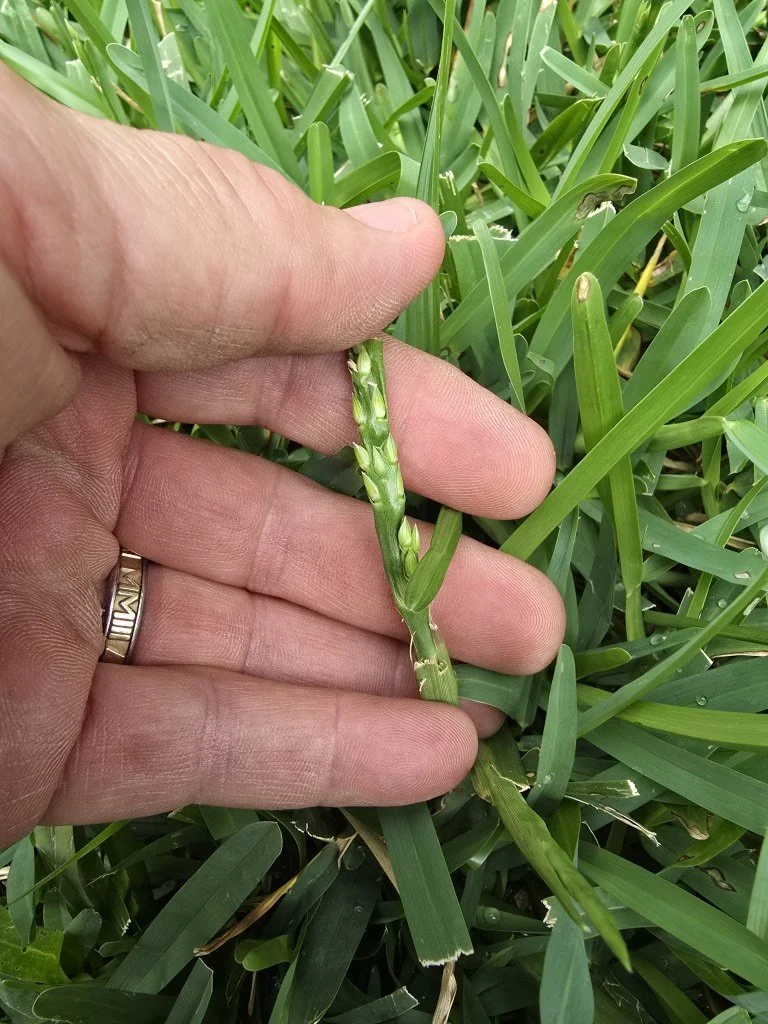
Then somebody else says: "If you leave those alone, they'll reseed your lawn and make it thicker."
And that's where things go sideways.
One Facebook post on this topic recently reached over 250,000 people — because almost every St. Augustine homeowner has wondered about this at some point. So let's settle it once and for all.
What Are Those Little Stalks in My St. Augustine Grass?
They are St. Augustine grass seed heads — the flowering, reproductive part of the grass plant. On St. Augustine, they typically look like a short spike or stalk standing up above the blades. Up close, you'll see small seed-like structures arranged along the stalk in a herringbone pattern.
They are:
Real and totally normal
Not weeds
Not nutsedge or kyllinga
Not crabgrass
Not something you need to spray
Not a cause for alarm
They appear most often in spring and early summer when temperatures are rising and your St. Augustine is pushing new growth. If the grass got a little tall between mowings, you may notice them more — the plant simply had enough time to produce them.
That is not an emergency. That is an observation.
The Big Myth: "Leave Them Alone and They'll Reseed Your Lawn"
This sounds completely logical. You see seed heads. Seeds make more grass. Leave them alone, let them fall, and your thin spots fill in.
That is not how St. Augustine works.
Here's the truth: those seeds are sterile. Or at best, so inconsistently viable and impractical to establish that they are not a real-world repair strategy for homeowners. You cannot buy a bag of St. Augustine seed at the nursery. You cannot scatter seed over a bare spot and grow a lawn. If it were that simple, we'd all be doing it.
We are not — because St. Augustine grass is not established from seed.
How St. Augustine Is Actually Grown
St. Augustine spreads and establishes through vegetative propagation — meaning, pieces of living plant material, not seed.
In your yard, this happens through stolons — the above-ground runners that crawl sideways across the soil and root down at the joints. That is how St. Augustine fills in bare spots. That is how it knits together into a thick lawn. Not from seed. From runners.
At the sod farm level, it works the same way: sod producers plant starter material, manage fields to encourage dense runner production, then harvest, cut, and ship those living pieces to be installed as sod. The whole supply chain runs on vegetative propagation, not seed.
(Want to go deeper on how sod farms actually grow St. Augustine? We cover the full vegetative propagation process here.)
So What Should You Do When You See Seed Heads?
In most cases: nothing dramatic.
Do not spray herbicide on them
Do not scalp the lawn trying to remove them
Do not panic-text your neighbor
Do not accuse your lawn guy of bringing weeds
Just mow normally at a healthy height. In Houston-area St. Augustine, we like to keep the grass a little taller — around 3 to 3.5 inches. Taller grass shades the soil, protects the runners, and helps the lawn stay thick through the heat. Mowing too short weakens everything.
A good rule: never remove more than one-third of the blade at a single mowing. If the grass got tall and you're suddenly seeing seed heads everywhere, bring it back down gradually — don't scalp it trying to clean things up fast.
What Actually Makes St. Augustine Thicker?
If your lawn is thin, the seed heads are not the cause and they are not the cure. Thin St. Augustine has real reasons — and real fixes.
Common causes of thin St. Augustine:
Too much shade
Shallow, frequent watering that creates weak roots
Compacted or poor-quality soil
Chinch bug damage
Brown patch or other fungal problems
Mowing too low (scalping)
Tree roots competing for water and nutrients
Old unrepaired damage
What actually thickens St. Augustine:
Improve the soil. Weak soil = weak grass. If your soil is compacted clay, roots and runners can't do their job. A soil test through Texas A&M is a great starting point. Get our Soil Guide here →
Water deeply, not constantly. Shallow daily watering creates shallow roots. St. Augustine wants deep morning watering — letting the soil dry slightly between cycles encourages roots to go down and find moisture.
Mow correctly. Keep it tall. Protect the blades and runners. Don't scalp.
Fertilize at the right time with the right product. Not sure what to use? We can help you choose →
Watch for pests and fungus. Chinch bugs and brown patch can thin a lawn fast and quietly. Catch them early.
Use sod pieces for bare spots. If an area is truly bare, help it with living St. Augustine. Cut a piece of healthy sod, press it into properly prepped soil, water it in, and let the runners take over. That is the real plan — not waiting on seed heads to perform a miracle.
The Bottom Line on St. Augustine Seed Heads
Those little stalks are St. Augustine seed heads. They are normal, they are not weeds, and they are not going to reseed your lawn into a lush carpet. The seeds are sterile and impractical — they are not a repair plan.
Your St. Augustine thickens through healthy runners, good mowing, deep watering, healthy soil, proper fertilizer, and sod pieces where needed.
That's it. That's the whole program.
Helpful Garden Guy Resources
🌱 Improve Your Soil Guide — includes the Texas A&M soil testing link
🌱 Pick My Fertilizer Service — we help you choose based on your lawn and situation
🌱 Garden Guy Fertilizer Store — our recommended options in one place
☕ This advice worth a cup of coffee? — support free lawn help here
— Todd
Garden Guy Inc. | askgardenguy.com
