How to Kill Nutsedge (Nutgrass) in Houston
Nutsedge is the weed Houston homeowners hate most. Here's how to actually beat it — and what most people get completely wrong.
The Question
The Question We Hear All the Time
"I keep pulling this grassy-looking weed and it just keeps coming back. It's everywhere and nothing I spray seems to touch it. What is it and how do I get rid of it?"
Nine times out of ten — that's nutsedge. Also called nutgrass. It is one of the most stubborn weeds in the Houston area, and it shows up in nearly every yard we visit across Sugar Land, Missouri City, Katy, Pearland, and the surrounding communities. The good news is there is a real system for beating it. The bad news is most homeowners are fighting it the wrong way — and actually making it worse every time they try.
Know Your Enemy
What Nutsedge Actually Is
This is where most people go wrong before they ever open a product. Nutsedge is not a grass. It is not a broadleaf weed. It is a sedge — a completely different plant family — and that means most of what is sitting in your garage right now will not touch it. Regular broadleaf weed killers won't work. Weed-and-feed won't work. Even pulling it out makes things worse. More on that in a moment.
The visual that gives it away every time: look at the color. Nutsedge is a lighter, brighter yellow-green than your surrounding St. Augustine or Bermuda. It also grows noticeably faster — it sticks up above the lawn days after you mow, like it didn't get the memo. Once you know what you're looking for, you'll spot it everywhere.
How to Identify It
Before you spray anything, confirm what you actually have. Here's how to know for certain:
How to ID nutsedge in your lawn:
Stem — Roll it between your fingers. Three distinct sides, like a triangle. Regular grass stems are round and hollow.
Leaves at the base — Three leaves sprouting from one shoot. Regular grass sends up two.
Color — Lighter yellow-green than your surrounding turf. It stands out.
Growth rate — Grows noticeably faster. Sticks up above the lawn between mowings.
Seed head — Small branched umbrella shape at the top when unmowed.
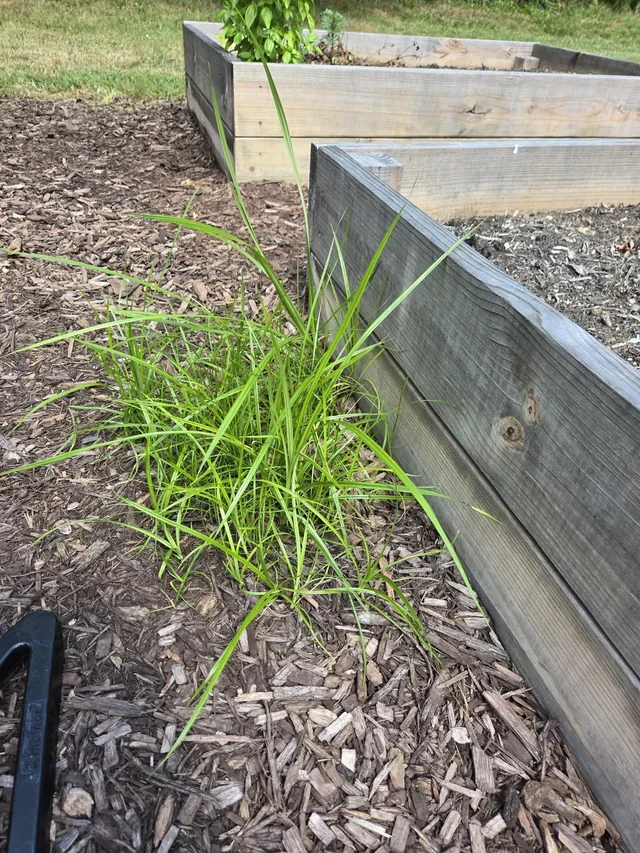
Nutsedge or nutgrass as you would normally see it in your garden or lawn areas.
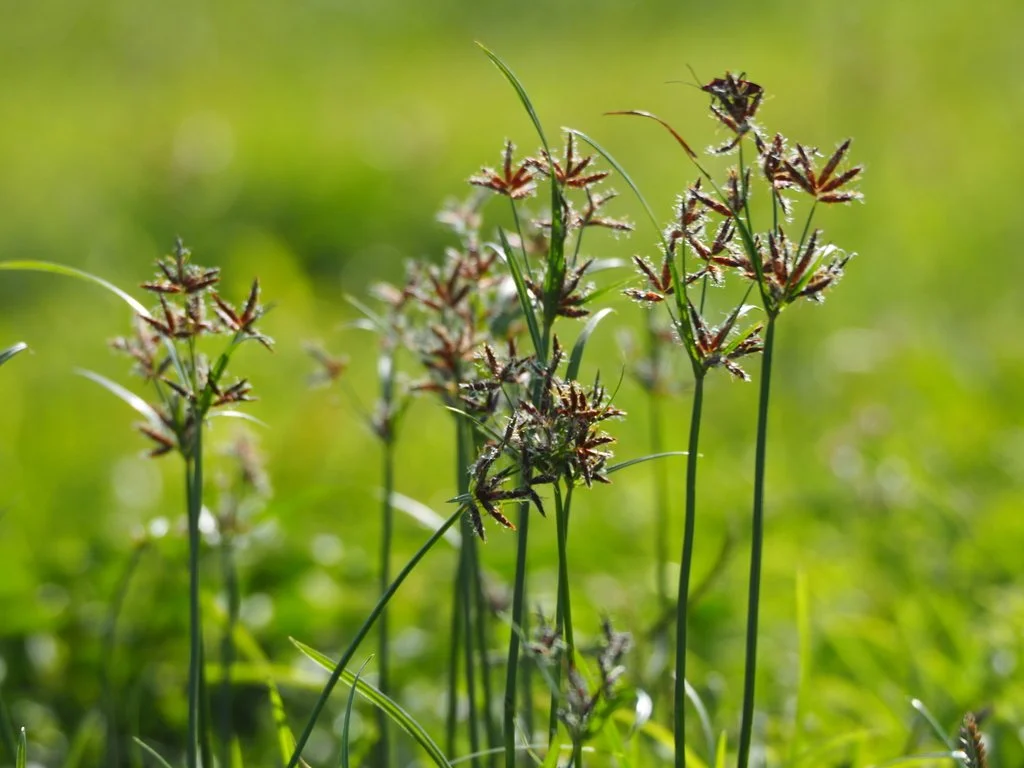
Purple nutsedge
That lighter green clump standing out from the surrounding St. Augustine — that's nutsedge. Look at the base: three leaves coming from a single shoot. Roll the stem between your fingers and feel the triangle. That's your confirmation right there.
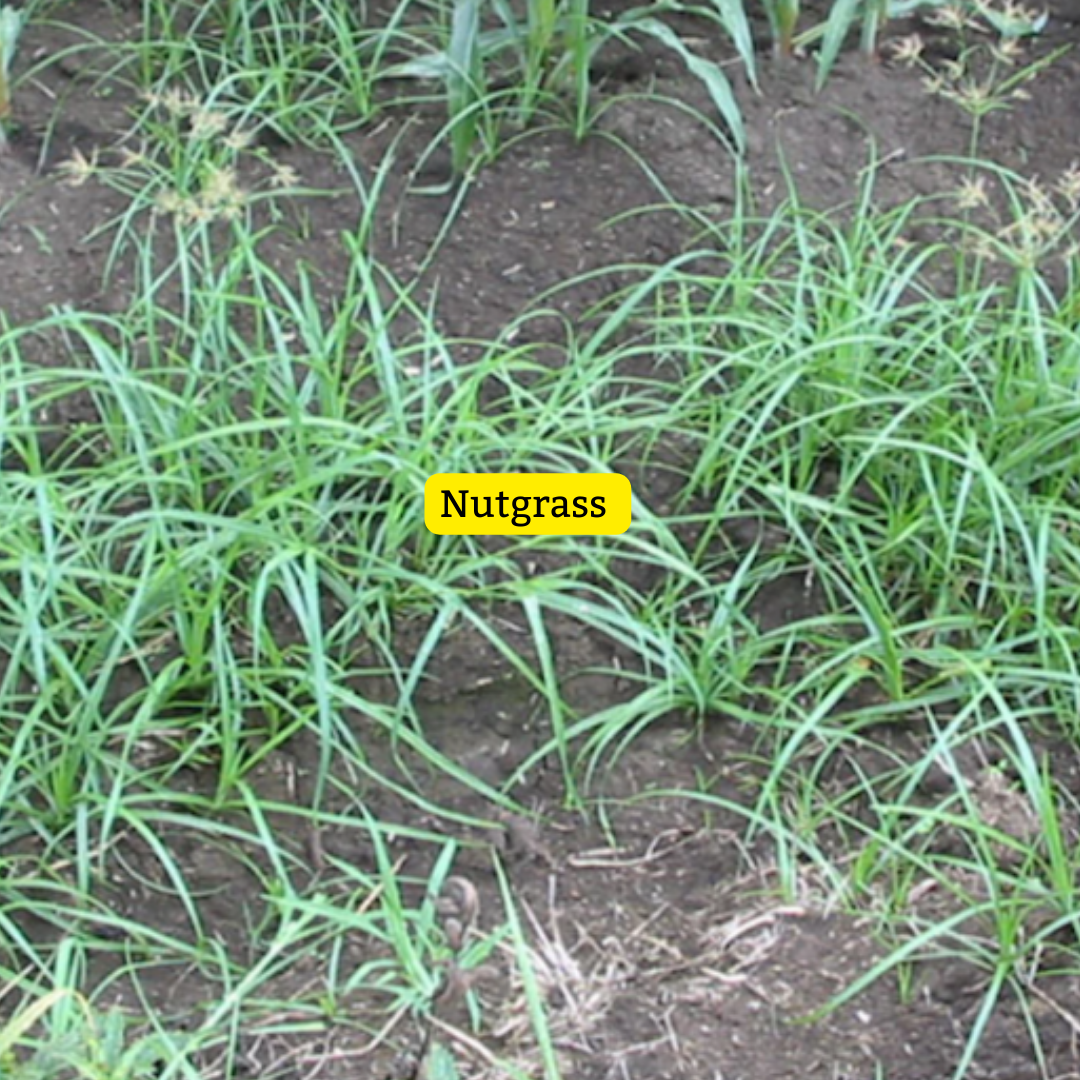
This is what a nutsedge infestation looks like when it's been left unchecked — and why getting on it early matters. Each of those plants is connected to an underground tuber network actively producing more.
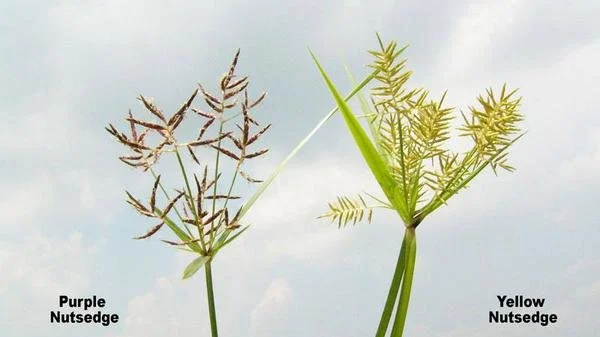
Courtesy of NC State Extension - The difference between purple and yellow nutsedge.
Houston has two common types. Yellow nutsedge has yellow-green leaves and a light branched seed head — by far the most common in Houston lawns. Purple nutsedge is darker green with a reddish-purple seed head and tends to show up more in landscape beds and disturbed soil. Both love our clay, our humidity, and our tendency to overwater. Purple is slightly harder to knock out.
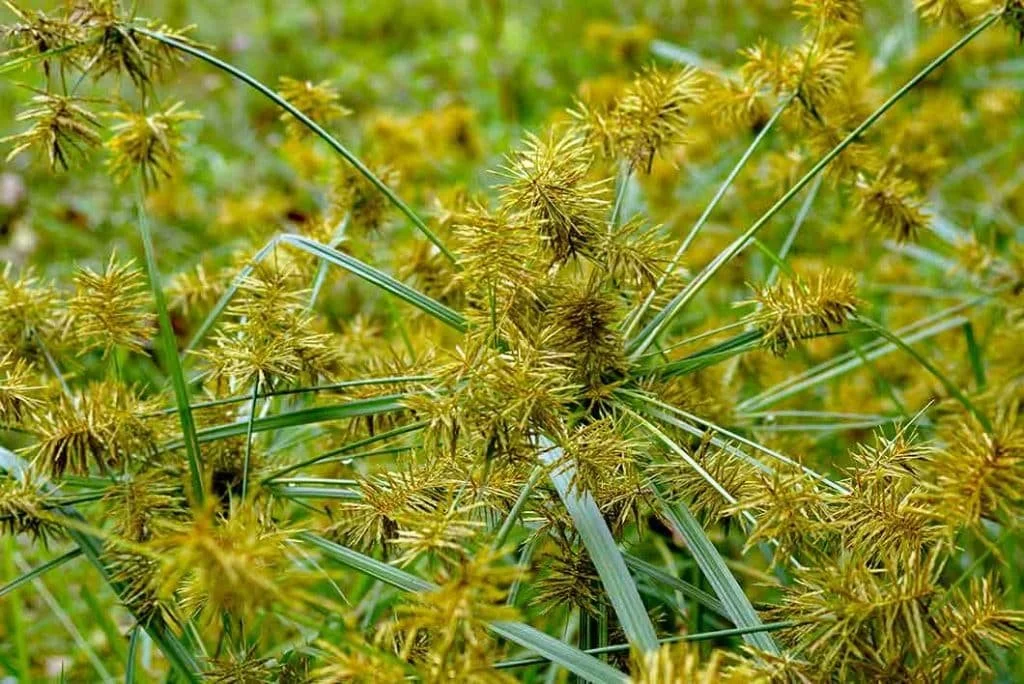
Yellow nutsedge has yellow-green leaves and a light branched seed head
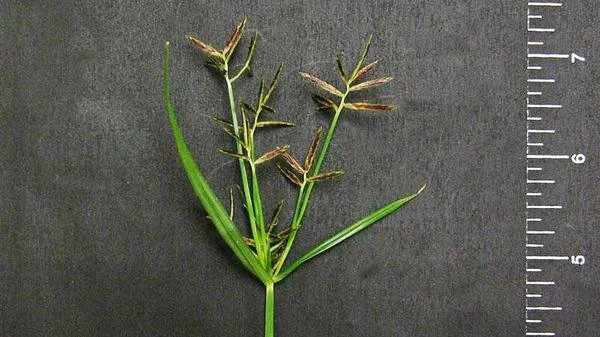
Purple Nutsedge Image NC State Extension
7,000
In one documented test, a single yellow nutsedge tuber produced 1,900 new daughter plants and 7,000 new tubers in a single growing season. This is why you cannot pull your way out of a nutsedge problem.
Why Houston is prime nutsedge territory: Nutsedge loves warm temperatures, moisture, and compacted or disturbed soil — and we have all three in abundance. It flushes hardest from May through September and wakes up fast after any lawn renovation, new sod installation, grading, or construction. If your soil was disturbed in the last year or two, the tuber bank underground may already be loaded and waiting.
The Biggest Mistake
Stop Pulling It by Hand
We know it's satisfying. You see it, you pull it, it's gone. Except it isn't.
Each nutsedge plant is connected underground to a chain of small tubers called nutlets. When you pull the visible plant, you snap the connection — and those nutlets stay in the ground. They then sprout into multiple new plants. You are not removing nutsedge when you pull it. You are multiplying it. That 7,000 tubers number above is why hand-pulling feels endless. You are fighting the underground bank, not the plant you can see.
The same goes for rototilling a heavily infested area without a follow-up plan. Breaking up tuber chains and spreading them around can actually increase the infestation. If you need to till, follow immediately with a targeted herbicide program as new sprouts emerge.
What Actually Works
The Right Products for Houston Lawns
The only reliable way to control nutsedge in a Houston lawn is a selective sedge herbicide — one specifically labeled for sedge control. Two products we recommend for homeowners:
Sedgehammer (halosulfuron-methyl)— Our top pick for Houston St. Augustine and Bermuda lawns. Safe for both grass types. Can be used throughout the growing season. Moves through the plant systemically and attacks the root system and tubers beneath the soil. Takes 2–3 weeks to show full results — don't panic if it looks slow. Repeat applications are normal and expected.
Dismiss (sulfentrazone)— Works faster visually than Sedgehammer, which can be reassuring when you want to see activity. Also labeled for St. Augustine and Bermuda. Good option when you are dealing with a heavy flush and want faster knockdown. May require more repeat applications for deep-rooted infestations.
→ Shop nutsedge control products in our Amazon store
The Surfactant Rule — Do Not Skip This
Nutsedge has a waxy, glossy leaf surface. If you spray a herbicide on it without a surfactant, the product will bead up and roll right off before it can absorb. A non-ionic surfactant breaks that surface tension and helps the product stick and penetrate the leaf. This is one of the most common reasons nutsedge treatments fail — the product was right, the timing was right, but the surfactant was missing.
Add non-ionic surfactant at approximately 1 teaspoon per gallon of spray mix. Always read the product label for exact rates for your specific herbicide.
How to Apply
Spray when nutsedge is actively growing — ideally when plants have 3 to 5 leaves. Earlier is better. Don't wait until it has fully matured and is spreading seed.
Apply on a sunny, calm day with no rain expected for at least 24 hours. Morning applications work well.
Temps should be above 65°F. Hot Houston summer days are perfectly fine — these products handle our heat.
Use a dedicated sprayer. Rinse it thoroughly after use to protect desirable plants you spray later.
Wait 2 to 3 weeks between applications. New plants will emerge from dormant underground nutlets — that is normal and expected. Spray those too as they appear.
In heavy infestations, plan for a multi-season approach. Nutlets can survive in the soil for more than three years and will continue to germinate. Each season you spray consistently, you are drawing down that underground bank.
Set the right expectation: Nutsedge control is a process, not a single event. Even with the right product and correct application, new plants will emerge from dormant nutlets. That is not failure — that is how this weed works. The goal of each spray is to prevent those new plants from maturing and producing more tubers. Stay consistent and the pressure decreases season over season. Most Houston homeowners see meaningful improvement by the second season of a proper program.
What Not to Do
What Not to Do
❌ Don't pull nutsedge by hand — you are spreading the underground nutlets.
❌ Don't use weed-and-feed — it has no effect on sedge whatsoever.
❌ Don't use regular broadleaf weed killers — nutsedge is not a broadleaf, they won't work.
❌ Don't spray without a surfactant — the product will bead off the waxy leaf and do nothing.
❌ Don't spray before rain — you will wash the product off before it can absorb.
❌ Don't spray a lawn that is already severely heat or drought stressed — address the stress first.
❌ Don't expect one application to solve a heavy infestation — patience and repetition are the strategy.
Know the Difference
Wait — Is That Kyllinga?
If the weed in your lawn has a small round or oval seed head — almost like a tiny green pea or ball sitting on top — it may not be nutsedge at all. It could be Kyllinga (pronounced kuh-LING-uh), a closely related sedge that shows up frequently across Houston and is constantly mistaken for nutsedge or fine-bladed turf grass.
It matters because Kyllinga spreads aggressively by above-ground stolons and underground rhizomes, forming dense low mats that can choke out surrounding turf entirely if left unchecked. Early identification and early treatment make a real difference with this one.
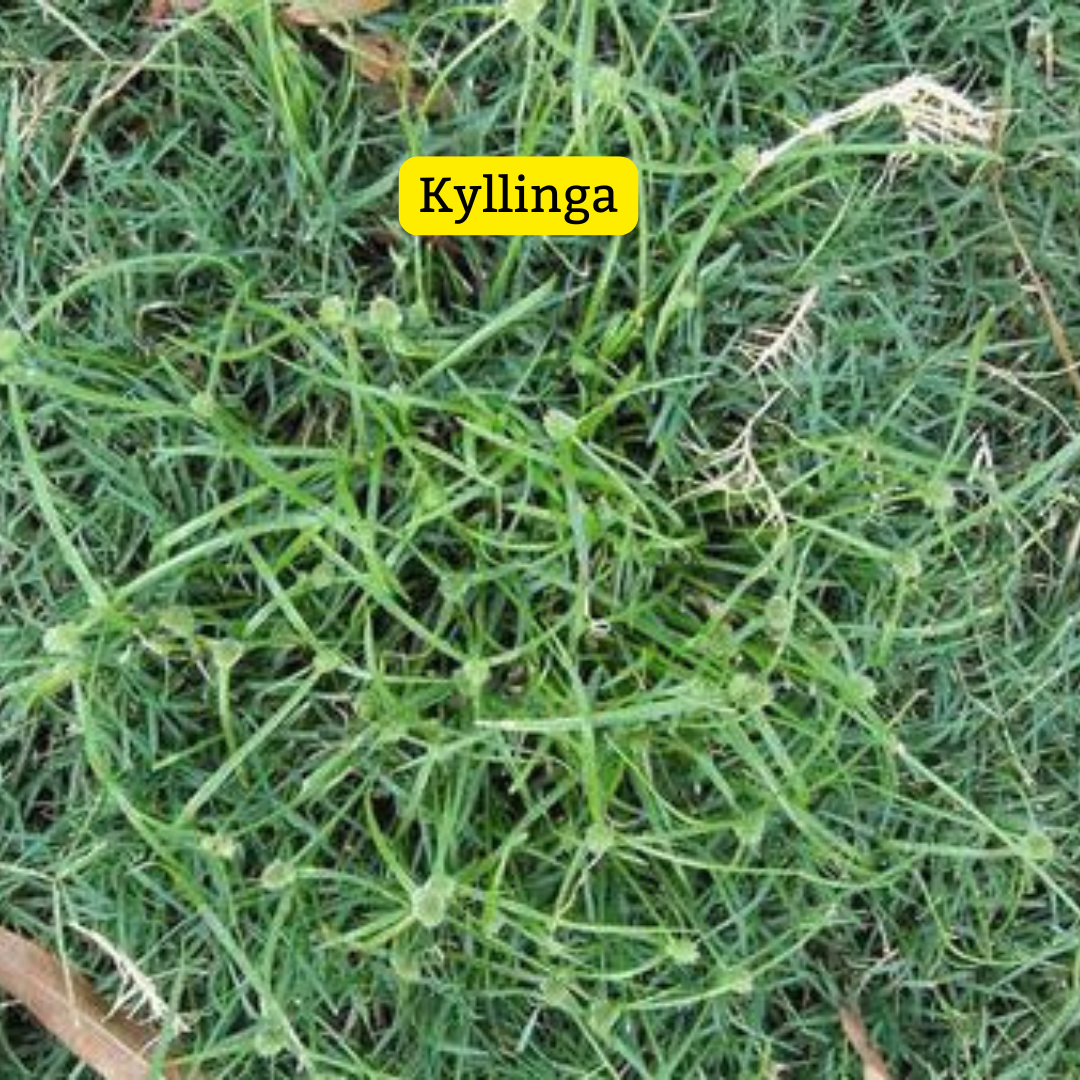
Kyllinga in particular loves getting into beds this way. If the seed head is round like a ball rather than branched like an umbrella, you've got Kyllinga, not nutsedge. Same family, same fix — but good to know which one you're dealing with.
How to tell Kyllinga apart from nutsedge:
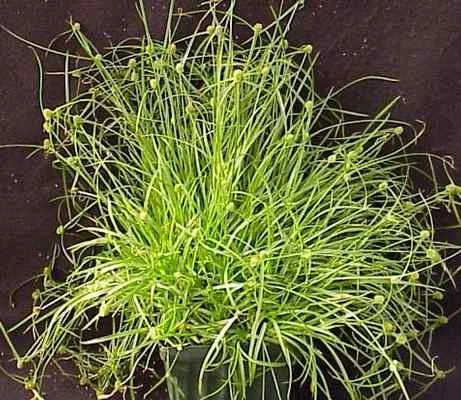
Kyllinga
— The seed head is the giveaway. Round and compact, like a small ball or pea. Nutsedge seed heads are open and branched, like a tiny umbrella.
— Leaves are glossier than nutsedge or turfgrass. In the morning, dew rolls off Kyllinga leaves while staying on the surrounding turf — one of the easiest ways to spot it early before it matures.
— Crush or mow a leaf and smell it. Kyllinga has a distinctive minty-sweet scent. Nutsedge does not.
— Growth habit is low and mat-forming rather than upright like nutsedge.
→ Shop Kyllinga control products in our Amazon store
The good news: Sedgehammer and Dismiss work on Kyllinga too. Same surfactant rule applies. Same timing approach. Getting the ID right first saves you from spending money on the wrong product entirely.
Going Chemical-Free
Non-Chemical Options
If you prefer to avoid herbicides, physical methods can help — particularly in landscape beds or areas being fully renovated. Dense landscape fabric can starve nutsedge of sunlight and deplete tuber reserves over time. Soil solarization — covering moist soil with clear plastic during peak Houston summer — can kill tubers in the top few inches. These approaches require patience and work best as part of a complete bed renovation, not as a standalone fix in an established lawn. For active turf areas, selective herbicide is almost always the more practical and effective path.
From the Mailbag
A Real Question from Katy — Paul's Story
Paul — Katy, TX
"Fighting nutsedge in several areas including some mid-turf areas and in an old garden area where I believe I spent about 50 hours hand tilling and pulling out the roots. I now know that probably made it worse. Sedgehammer? Other best treatments that won't wipe everything else out?"
Paul — first, thank you for the kind words, and yes, you are absolutely right. Fifty hours of hand tilling and pulling nutsedge almost certainly made it worse. The underground nutlets break apart when you disturb the soil and each one becomes a new plant. You are not alone on that one. We hear it constantly.
Here is exactly what we told Paul, and it applies to anyone in the same situation:
For nutsedge in turf areas — use Sedgehammer. It is formulated specifically for sedges, which means it is targeted and won't harm your surrounding St. Augustine or Bermuda when used correctly. Regular broadleaf sprays and weed-and-feed products won't touch nutsedge — it is neither a grass nor a broadleaf, it is a sedge, and it needs a sedge-specific herbicide.
Sedgehammer Plus — best for smaller spot treatments. The surfactant is already included, so you just mix and spray.
Regular Sedgehammer — better for larger areas. You must add a non-ionic surfactant separately or it won't absorb properly through the waxy leaf surface.
→ Shop Sedgehammer products in our Amazon store
Application notes that matter:
Spray when nutsedge is actively growing — about 4 to 6 inches tall is ideal. Don't wait until it's fully mature.
Do not mow 2 days before or 2 days after spraying. The plant needs leaf surface to absorb the product, and a fresh mow removes that.
Expect more than one round. Nutsedge typically takes 2 to 3 treatments spaced 6 to 10 weeks apart as new plants emerge from dormant nutlets.
For the old garden area, Sedgehammer can be used carefully around desirable plants — always read and follow the label. We would not recommend glyphosate in or near lawn areas unless you are prepared to kill the surrounding turf and start over.
Check your watering before anything else. Nutsedge loves wet soil, frequent irrigation, low spots, and sprinkler heads that hit too often. If an area stays consistently moist, nutsedge will keep coming back even after a correct treatment program. Fix the irrigation or drainage issue first — otherwise you are treating a symptom, not the cause.
Paul also got our free Texas Lawn Weed ID and Eradication Guide with his reply — it covers nutsedge plus every other major weed showing up in Katy lawns right now.
→ Download the free Texas Lawn Weed Guide here
Advanced Technique
Nutsedge Near Vegetables, Flowers, or Desirable Plants — The Q-Tip Method
This is the question we get almost as often as the main nutsedge question, and it almost never gets answered well anywhere else. What do you do when nutsedge is growing right next to tomatoes, peppers, herbs, roses, or other plants you can't afford to damage with a herbicide spray?
You don't spray. You paint.
The Q-Tip method for nutsedge near desirable plants:
Mix your Sedgehammer solution in a small cup at the standard label rate with surfactant included. Put on gloves. Dip a cotton swab or small foam brush into the solution and carefully wipe it directly onto the nutsedge leaves — top and bottom if you can. Avoid contact with any surrounding desirable plants. The product absorbs through the leaf surface and moves systemically down to the roots and tubers.
Repeat every 2 to 3 weeks as new plants emerge. It takes patience, but it works — and it protects everything around it.
Where this technique matters most:
Vegetable gardens — nutsedge loves to push up through raised beds and garden borders. Spraying anywhere near edibles is not worth the risk. The Q-tip method lets you treat individual plants without putting any product near your food crops.
Flower beds — roses, perennials, and annuals are often sensitive to herbicide drift. Wiping directly onto the nutsedge leaf eliminates that risk entirely.
Landscape beds with mixed plantings — anywhere the nutsedge is intertwined with ground covers, ornamental grasses, or shrubs where a sprayer would hit too many things at once.
Container gardens and patio pots — nutsedge will find its way into containers through drainage holes or potting mix. The Q-tip is the only safe treatment method here.
A few important notes on the Q-tip method:
— Always wear gloves. Even diluted herbicide should not contact your skin repeatedly.
— Use a dedicated cup and swab. Don't dip back into your main spray mix after touching the weed — keep it clean.
— Don't wipe and then water. Give it at least 24 hours before any irrigation hits the treated area.
— This method works on Kyllinga in beds too — same technique, same product, same patience required.
— For very dense infestations in a garden bed, consider removing the desirable plants temporarily, treating aggressively for a season, then replanting. Sometimes the cleanest path forward is a full reset.
No other weed control guide for Houston is going to tell you to grab a Q-tip. But sometimes the right tool is the most precise one you have — and in a vegetable garden or a mixed bed, precision is everything.
When to Ask for More Help
When to Ask for More Help
If you have applied a selective sedge herbicide correctly — with surfactant, at the right timing, with repeat applications — and still see heavy pressure after a full season, it may be time to get a second set of eyes on the situation. Some infestations involve multiple sedge species at once, or underlying irrigation and drainage issues that are continuously recharging the tuber bank from neighboring areas.
If you are not entirely sure what you are dealing with — nutsedge, Kyllinga, dallisgrass, or something else — don't spend money on a product that may not be right for your situation. Send us a photo or book a call with Todd. Getting the ID right before you spray is always the better first move.
Not sure what's taking over your lawn? Todd can help you identify it and put together a real plan.
Free Resources
Helpful Links
If this helped you finally figure out what's taking over your lawn, a couple cups of coffee are always appreciated — it's how we keep answering these questions for free.
— Todd & Sabrina
