Find it · Check your grass · Fix it
The Texas Lawn Weed Guide
33 Texas lawn weeds with photos, and for every one, what kills it without killing your St. Augustine, Bermuda or Zoysia.
By Todd Farber, Aggie horticulturist · Garden Guy, since 1991

Todd & Sabrina (fence photo)
One fix each.
Step 1
What grass do you have?
Pick one. Every weed below will highlight whether its fix is safe on your lawn.
Showing safety for all three grasses.
First, know which of the 3 kinds you have
Every lawn weed falls into one of three groups, and each group needs a different product. That's why the wrong spray does nothing.
Sedges
Look like grass, but the stem is solid and triangular. Roll it between your fingers and you'll feel the edges. Regular weed killers miss them.
See the sedges →Grassy weeds
Real grasses with round or flat, hollow stems. They're the hardest to remove, because what kills them can kill your lawn too.
See the grassy weeds →Broadleaf weeds
Wide leaves with veins, and often flowers. The good news: most of these are easy to kill safely.
See the broadleaf weeds →Step 2
Find your weed by photo
Tap the one that looks like yours to jump to how to kill it. Or type a name you've heard.

A nutsedge clump standing taller and lighter green than the lawn a few days after mowing

A mat of kyllinga in the lawn, darker and finer than the grass around it

A dallisgrass clump in a St. Augustine lawn, showing its circular shape

A crabgrass plant sprawling flat in thin turf or along a sidewalk

Bright-green Poa patches standing out in a tan, dormant lawn

Bahiagrass seed heads sticking up above a mowed lawn

Bermuda runners creeping into a St. Augustine lawn or over a sidewalk edge

Johnsongrass standing tall along a fence line or lawn edge

A torpedograss patch with stiff upright blades in a lawn

A sandbur plant in a thin, sandy lawn

A mat of doveweed in a St. Augustine lawn

Virginia buttonweed spreading through a lawn

A dollarweed patch in a wet section of lawn

A dichondra mat in a shady lawn

Oxalis growing in the lawn with yellow flowers

Mock strawberry runners in a shady lawn

Chamberbitter plants coming up in the lawn or mulch

A spurge mat spreading flat in a thin lawn or along a sidewalk

Horseherb carpeting a shady lawn under a tree

Aster plants standing up along a curb or alley edge of the lawn

A lespedeza mat in a thin lawn

Sensitive plant / catclaw briar sprawling in a lawn

A dandelion rosette in the lawn with a yellow flower

A clover patch in the lawn with white flowers

A thistle rosette flat in the lawn

Bedstraw scrambling over the lawn or a bed edge

A chickweed mat in a winter lawn

Lawn burweed plants in a winter lawn

A henbit patch with purple flowers

Young hedge parsley in a winter lawn

Florida betony growing in the lawn

Carolina geranium plants in a winter lawn

A plantain rosette in the lawn
No match for that name. Try another, or send us a photo below.
Free weed ID
Can't match it? Send Todd a photo.
Snap a picture of the weed, ask your question, and Todd, our Aggie horticulturist, will tell you what it is and how to get rid of it.
Step 3 · Read this once
Before you spray: 4 rules that save your lawn
Most lawn damage we see comes from the right product used the wrong way. Read these, then go find your weed.
1. The surfactant rule
A surfactant (spreader-sticker) helps spray stick to waxy weed leaves. It helps a lot. But with the wrong product on the wrong grass, it can burn your lawn.
| YES | Sedgehammer bottle (1.33 oz): always add a non-ionic surfactant. The label requires it. The Sedgehammer Plus packets already have it inside. |
| YES | Celsius WG on Bermuda or Zoysia, or a whole-zone spray on St. Augustine: add non-ionic surfactant, 1.5 tsp per gallon. |
| NO | Celsius WG spot spray on St. Augustine: no surfactant. It can damage St. Augustine at the crown. |
| NO | Ready-to-use and hose-end bottles: use them as they come. |
| NO | 90°F or hotter: skip surfactant on any product, and spray in the cool of early morning. |
| LABEL | Everything else: if the label says to add a non-ionic surfactant, add it at the label rate. If it doesn't, don't. |
2. Mind the heat
Spray early in the morning, on a calm day, with no rain coming for 24 hours. Broadleaf sprays like Weed Free Zone and Weed Beater Ultra can hurt St. Augustine above about 85°F and during spring green-up, so save them for fall and late spring, and don't use them on Floratam St. Augustine at all. Celsius works best when it's warm, with daily average temps above 60°F.
3. Spot-spray. Don't blanket.
Spray only the weeds, not the whole yard. A little blue marker dye shows you where you've been. Most weeds that come back every year need 2–3 rounds over a season or two. One spray won't do it, so don't give up.
4. Know what Celsius WG will and won't do
Celsius WG is our go-to because it's safe on St. Augustine, Bermuda and Zoysia, including in summer. It's labeled for 22 of the 33 weeds in this guide:
- Green Kyllinga
- Crabgrass
- Johnsongrass
- Grass Burrs (Sandbur)
- Doveweed
- Virginia Buttonweed
- Dollarweed
- Dichondra
- Oxalis
- Chamberbitter
- Spotted Spurge
- Slender Aster
- Lespedeza
- Dandelion
- White Clover
- Thistle & Sowthistle
- Chickweed
- Lawn Burweed
- Henbit
- Florida Betony
- Carolina Geranium
- Plantain
It won't handle nutsedge, Poa annua, Bermuda or torpedograss, so each of those has its own fix below. Don't use Celsius on a Bahia lawn. Keep it 15 feet away from vegetable gardens and outside the drip line of fruit trees.
How to read the safety boxes
"Use care" means read the label for your grass, use the lawn rate, and skip hot days. Always read and follow the product label. It's the law, and it beats any guide, including this one.
Free · Printable
Take this guide to the garage
Get the printable Texas Lawn Weed Guide, the new edition, emailed to you free.
- All 33 weeds with photos and their giveaways
- The "Is it safe on my grass?" spray chart for the fridge
- When to spray, season by season
Free. No spam. Unsubscribe anytime.
2 weeds
Sedges
Grass-looking weeds with triangular stems. Regular weed killers miss them.
A nutsedge clump standing taller and lighter green than the lawn a few days after mowing
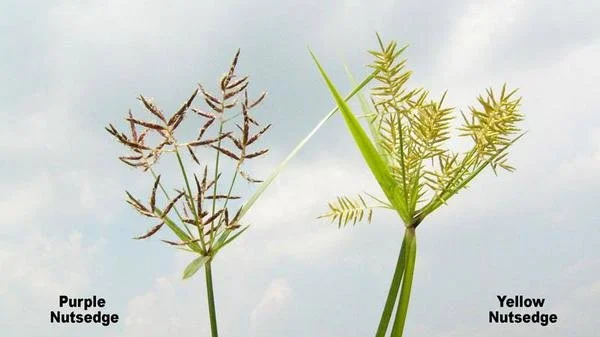
Close-up of the umbrella-shaped yellow seed head, or a cut stem showing the triangle
Nutsedge
Nutgrass · yellow & purple nutsedge · Cyperus esculentus / C. rotundus
The giveaway: Roll the stem between your fingers. It's triangular. Sedges have edges.
How to spot it
- Shiny, lighter-green blades growing in sets of three from the base
- Pops up above the lawn 2–3 days after you mow
- Underground "nuts" (tubers). Pull the top and the nut sprouts again
Why it's in your lawn: Too much water, wet low spots, and new sod.
Garden Guy's fix
Sedgehammer (halosulfuron). Small yards: Sedgehammer Plus packets, which already have surfactant inside. Bigger yards: the 1.33 oz bottle plus a non-ionic surfactant. Spot-spray young plants and plan on 2–3 rounds, 6–10 weeks apart. Don't just pull it: that snaps off the tubers and it comes back. If you dig, get every tuber. Starting over in a bed or a spot you'll re-sod? Solarize: cover it with clear plastic for 6–8 weeks in peak summer heat to smother the nutgrass. It kills the grass under the plastic too, so spray anything that comes back.
- Will Celsius kill it? No. It's not on the Celsius label, so use the fix above.
- Surfactant: Sedgehammer Plus: already inside. Sedgehammer bottle: add non-ionic surfactant (the label requires it).
- Best time: Late spring through summer, while plants are young (before 5–6 leaves).
The full nutgrass battle plan → · Often confused with Green Kyllinga · Not sure? Send Todd a photo · ↑ Back to the photo finder
A mat of kyllinga in the lawn, darker and finer than the grass around it
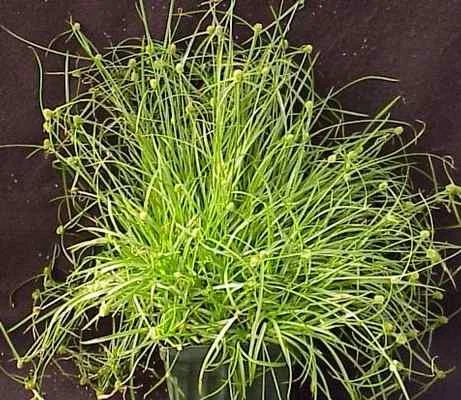
Close-up of the round green button seed head on its stem
Green Kyllinga
Watergrass · Kyllinga brevifolia
The giveaway: A small round green "button" seed head sitting on top of a thin triangular stem.
How to spot it
- Fine, dark-green, grass-like blades that form a thick mat
- Triangular stem like nutsedge, but shorter and thinner
- Spreads by runners, not by nuts
Why it's in your lawn: Wet, overwatered, poorly drained spots.
Garden Guy's fix
Celsius WG spot spray, or Sedgehammer. Both are safe on St. Augustine, Bermuda and Zoysia. Repeat in 6–8 weeks, and fix the watering or it comes right back.
- Will Celsius kill it? Yes. It's on the Celsius WG label.
- Surfactant: Celsius spot spray on St. Augustine: no surfactant. Sedgehammer Plus packets already have it inside, so add nothing.
- Best time: Spring through summer.
Often confused with Nutsedge · Not sure? Send Todd a photo · ↑ Back to the photo finder
8 weeds
Grassy Weeds
Weeds that look like grass, because they are grass. The hardest group to remove from a lawn.
A dallisgrass clump in a St. Augustine lawn, showing its circular shape

Close-up of the seed stalk with the black speckles
Dallisgrass
Paspalum dilatatum
The giveaway: A coarse clump that grows outward in a circle, with tall seed stalks speckled with black dots.
How to spot it
- Wider, lighter-green blades than the grass around it
- Grows from the center outward and gets bigger every year
- Seed stalks shoot up within days of mowing
Why it's in your lawn: Thin spots and seed carried in on mowers.
Garden Guy's fix
No spray safely removes dallisgrass from St. Augustine. Dig out the clump with all its roots, or spot-kill it with glyphosate and patch the hole with fresh sod. Celsius only slows it down.
- Will Celsius kill it? Only slows it down (suppression), so it's not the answer here.
- Surfactant: Glyphosate: follow the label (many already contain surfactant).
- Best time: Spring to early summer while it's growing. You can dig it any time.
Often confused with Bahiagrass · Not sure? Send Todd a photo · ↑ Back to the photo finder
A crabgrass plant sprawling flat in thin turf or along a sidewalk

Close-up of the finger-like seed head
Crabgrass
Digitaria spp.
The giveaway: Wide, pale blades that sprawl flat from the center like crab legs, with finger-like seed heads.
How to spot it
- Lighter green than your lawn, and grows faster
- 3–9 skinny "fingers" on each seed head
- Dies at the first frost and leaves bare spots behind
Why it's in your lawn: A thin lawn, mowing too short, and bare spots.
Garden Guy's fix
Stop it before it starts: put down a pre-emergent in late January to February, before soil reaches 55°F, and again in April–May. Young crabgrass in St. Augustine: Celsius. In Bermuda or Zoysia, quinclorac also works, but quinclorac is NOT for St. Augustine.
- Will Celsius kill it? Yes. It's on the Celsius WG label.
- Surfactant: Follow the Surfactant Rule above.
- Best time: Pre-emergent late Jan–Feb (a few weeks later in North Texas). Spray young plants in spring.
Often confused with Dallisgrass · Not sure? Send Todd a photo · ↑ Back to the photo finder
Bright-green Poa patches standing out in a tan, dormant lawn
Poa Annua
Annual bluegrass · Poa annua
The giveaway: Bright, shiny, light-green tufts in a tan winter lawn. The leaf tip is shaped like the front of a boat.
How to spot it
- Little whitish seed heads, even when mowed short
- Forms patches in shade and wet spots
- Dies in late spring heat and leaves holes
Why it's in your lawn: Wet, compacted or shady spots. It sprouts in fall.
Garden Guy's fix
Win this one in the fall: a pre-emergent (Barricade, prodiamine or Dimension) in September–October. Already up? Certainty is safe on St. Augustine, Bermuda and Zoysia. On Bermuda or Zoysia only, Negate 37WG also works.
- Will Celsius kill it? No. It's not on the Celsius label, so use the fix above.
- Surfactant: Certainty: add a non-ionic surfactant, as the label directs.
- Best time: Pre-emergent Sept–Oct. Spray young plants Nov–Feb when it's under 85°F.
Bahiagrass seed heads sticking up above a mowed lawn

Close-up of the V-shaped seed head
Bahiagrass
Paspalum notatum
The giveaway: A tall seed stalk that splits into a "V" at the top: two spikes, like a wishbone.
How to spot it
- Coarse, open patches that don't match your lawn
- Seed heads pop up within days of mowing
- Tough, thick runners just under the surface
Why it's in your lawn: Seed from roadsides and old pastures, and thin turf.
Garden Guy's fix
In Bermuda: MSM Turf (metsulfuron) controls it. In St. Augustine and Zoysia, expect repeat treatments, or dig it out (or spot-kill it with glyphosate) and patch with sod. Celsius can't be used on a Bahia lawn.
- Will Celsius kill it? No. It's not on the Celsius label, so use the fix above.
- Surfactant: Follow the product label.
- Best time: Late spring through summer, while it's actively growing.
Often confused with Dallisgrass · Not sure? Send Todd a photo · ↑ Back to the photo finder
Bermuda runners creeping into a St. Augustine lawn or over a sidewalk edge
Bermudagrass (in St. Augustine)
Wiregrass · Cynodon dactylon
The giveaway: Fine, thin blades on wiry runners that creep over sidewalks and into flower beds.
How to spot it
- Much finer blades than St. Augustine
- Runners both above and below ground
- Turns brown first when it gets cold
Why it's in your lawn: It creeps in from neighbors' yards and takes over sunny spots where St. Augustine is thin.
Garden Guy's fix
No spray removes Bermuda from St. Augustine without hurting it. For small patches, dig it out (get the runners) or spot-kill it with glyphosate, then re-sod. In Zoysia, Fusilade II mixed with Turflon Ester, sprayed every 3–4 weeks, can suppress it. Never use either one on St. Augustine. Edge your beds and keep St. Augustine thick in sunny spots.
- Will Celsius kill it? No. It's not on the Celsius label, so use the fix above.
- Surfactant: Glyphosate: follow the label. Fusilade II + Turflon Ester: add a non-ionic surfactant as the label directs.
- Best time: Late spring through summer, while it's growing hard.
Johnsongrass standing tall along a fence line or lawn edge

Close-up of a leaf showing the white center stripe
Johnsongrass
Sorghum halepense
The giveaway: Tall, wide blades with a bright white stripe down the middle.
How to spot it
- Shows up along fences, edges and in new lawns
- Reddish-purple seed heads if it isn't mowed
- Thick underground stems (rhizomes)
Why it's in your lawn: Rhizomes and seed coming in from fields, ditches and edges.
Garden Guy's fix
In a lawn that's mowed every week, Johnsongrass usually gives up. Celsius is labeled for it, so spot-spray young plants. Along fences and in beds, glyphosate or a grass killer like fluazifop (Fusilade II, Over-the-Top) works, but keep them OFF your lawn: both will kill St. Augustine and Bermuda.
- Will Celsius kill it? Yes. It's on the Celsius WG label.
- Surfactant: Follow the Surfactant Rule above.
- Best time: Spring and early summer, when plants are young.
A torpedograss patch with stiff upright blades in a lawn

Close-up of dug-up runners showing the sharp pointed tips
Torpedograss
Panicum repens
The giveaway: Stiff, upright blades on underground runners with sharp, pointed tips, like little torpedoes.
How to spot it
- Blue-green, stiff leaves held at an angle
- Pull one up: the runner tips are sharp and pointed
- Loves wet spots, ditches, pond edges and beds
Why it's in your lawn: Wet soil. It also arrives in sod or soil and creeps in from the edges.
Garden Guy's fix
The best fix is to dig it out, the whole patch and every runner, then re-sod. St. Augustine has no good selective spray: spot-kill the patch with glyphosate (it kills every grass it touches) and re-sod. In Bermuda or Zoysia, quinclorac can hold it back, but it suppresses rather than eliminates it. Quinclorac is NOT for St. Augustine.
- Will Celsius kill it? No. It's not on the Celsius label, so use the fix above.
- Surfactant: Follow the product label (most glyphosate already contains surfactant).
- Best time: Dig any time. Spray while it's actively growing, late spring through summer.
Often confused with Bermudagrass (in St. Augustine) · Not sure? Send Todd a photo · ↑ Back to the photo finder
A sandbur plant in a thin, sandy lawn

Close-up of the spiny burrs
Grass Burrs (Sandbur)
Stickers · sandspurs · Cenchrus spp.
The giveaway: Spiny burrs that stick to shoes, socks and dog paws.
How to spot it
- Low, clumping grass with flat, folded blades
- Burrs form by mid-summer
- Worst in sandy, thin, dry spots
Why it's in your lawn: Sandy, thin, dry turf.
Garden Guy's fix
Put down a pre-emergent in late winter to stop seedlings. Young plants: Celsius is labeled for field sandbur. Thicken the lawn, because burrs love thin spots.
- Will Celsius kill it? Yes. It's on the Celsius WG label.
- Surfactant: Follow the Surfactant Rule above.
- Best time: Pre-emergent late winter. Spray young plants before burrs form.
12 weeds
Summer Broadleaf Weeds
Leafy weeds that show up when it's hot and humid, roughly April through October.
A mat of doveweed in a St. Augustine lawn
Doveweed
Murdannia nudiflora
The giveaway: Shiny, thick, grass-like leaves (wider than a blade) with tiny purple-blue flowers.
How to spot it
- Low mats that root as they spread
- Glossy, almost succulent leaves
- Peaks in July and August, and looks like grass from a distance
Why it's in your lawn: Wet, overwatered, low spots.
Garden Guy's fix
Celsius WG is Todd's #1 pick. Hit it early in summer while it's small, and plan on two rounds 4–6 weeks apart. Cut back the watering in those spots.
- Will Celsius kill it? Yes. It's on the Celsius WG label.
- Surfactant: St. Augustine spot spray: none. Bermuda or Zoysia: yes.
- Best time: Early summer (June–July) while plants are small.
More on doveweed → · Often confused with Virginia Buttonweed · Not sure? Send Todd a photo · ↑ Back to the photo finder
Virginia buttonweed spreading through a lawn
Virginia Buttonweed
Diodia virginiana
The giveaway: Small white star-shaped flowers with 4 petals. The leaves are often speckled yellow.
How to spot it
- Narrow leaves in pairs along spreading stems
- Deep roots, and pieces of stem re-root
- Little button-like seed pods
Why it's in your lawn: Wet, poorly drained lawns. Mowing spreads the stem pieces.
Garden Guy's fix
Celsius WG is the gold standard on buttonweed. Spray the new growth in spring and repeat as needed. Improve drainage, and bag your clippings while it's blooming.
- Will Celsius kill it? Yes. It's on the Celsius WG label.
- Surfactant: St. Augustine spot spray: none. Bermuda or Zoysia: yes.
- Best time: Spring growth is best. Summer is OK in the cool of morning.
More on Virginia buttonweed → · Often confused with Doveweed · Not sure? Send Todd a photo · ↑ Back to the photo finder
A dollarweed patch in a wet section of lawn
Dollarweed
Pennywort · Hydrocotyle spp.
The giveaway: Perfectly round, shiny leaves the size of a coin, with the stem attached in the dead center.
How to spot it
- Looks like little lily pads
- Forms solid mats in wet areas
- Waxy, shiny top of the leaf
Why it's in your lawn: It's the #1 sign your sprinklers run too often.
Garden Guy's fix
Water less first. Then spot-spray with Celsius WG, which is on its label. In St. Augustine, atrazine also works in cooler weather.
- Will Celsius kill it? Yes. It's on the Celsius WG label.
- Surfactant: Follow the Surfactant Rule above.
- Best time: Spring through fall.
How long to water your lawn → · Often confused with Dichondra · Not sure? Send Todd a photo · ↑ Back to the photo finder
A dichondra mat in a shady lawn
Dichondra
Ponyfoot · Dichondra carolinensis
The giveaway: Small kidney-shaped leaves with a notch, like a little pony's hoof print, in a low mat.
How to spot it
- Creeping stems that root as they go
- Leaves smaller than dollarweed, and the stem is NOT in the center
- Likes moist shade
Why it's in your lawn: Moist shade and thin turf.
Garden Guy's fix
Celsius WG (Carolina dichondra is on the label). In cool weather, Bonide Weed Beater Ultra also works. On St. Augustine, use the lawn rate, skip spring green-up, and don't use it on Floratam.
- Will Celsius kill it? Yes. It's on the Celsius WG label.
- Surfactant: Follow the Surfactant Rule above.
- Best time: Spring and fall are best.
Often confused with Dollarweed · Not sure? Send Todd a photo · ↑ Back to the photo finder
Oxalis growing in the lawn with yellow flowers
Oxalis
Woodsorrel · Oxalis spp.
The giveaway: Three heart-shaped leaflets (a clover look-alike) and small yellow 5-petal flowers.
How to spot it
- Leaves fold up at night
- Little okra-shaped seed pods that pop open
- Spreads from flower beds into the lawn
Why it's in your lawn: Thin turf, and seed flung from nearby beds.
Garden Guy's fix
Celsius WG (yellow woodsorrel is on the label). Spray before the seed pods form. On St. Augustine, skip the "chickweed, clover & oxalis" killers: their labels say to avoid St. Augustine.
- Will Celsius kill it? Yes. It's on the Celsius WG label.
- Surfactant: Follow the Surfactant Rule above.
- Best time: Spring through fall, before seed pods.
Often confused with White Clover · Not sure? Send Todd a photo · ↑ Back to the photo finder
Mock strawberry runners in a shady lawn
Mock Strawberry
Potentilla indica
The giveaway: Looks like a strawberry plant with YELLOW flowers, and little red berries with no taste.
How to spot it
- Three toothed leaflets
- Spreads by runners
- Shady, moist spots
Why it's in your lawn: Shade and moisture.
Garden Guy's fix
Spot-spray with Weed Free Zone in cool weather, spring and fall. On St. Augustine, use the lawn rate, skip hot days and spring green-up, and don't use it on Floratam.
- Will Celsius kill it? No. It's not on the Celsius label, so use the fix above.
- Surfactant: Follow the product label.
- Best time: Spring and fall, under 85°F.
Chamberbitter plants coming up in the lawn or mulch
Chamberbitter
Gripeweed · Phyllanthus urinaria
The giveaway: Looks like a tiny mimosa tree, with a row of round seed beads hanging under the leaves.
How to spot it
- Upright stem with leaflets in two neat rows
- Reddish stems
- Pops up from mulched beds and spreads into the lawn
Why it's in your lawn: Wet summers, and seed from nearby beds.
Garden Guy's fix
Celsius WG (it's on the label). On St. Augustine or Zoysia, atrazine also works; keep it off tree and shrub roots. Use a pre-emergent like Barricade in spring, and pull it from beds before it seeds.
- Will Celsius kill it? Yes. It's on the Celsius WG label.
- Surfactant: Follow the Surfactant Rule above.
- Best time: Early summer while small.
Often confused with Sensitive Plant / Catclaw Briar · Not sure? Send Todd a photo · ↑ Back to the photo finder
A spurge mat spreading flat in a thin lawn or along a sidewalk
Spotted Spurge
Euphorbia maculata
The giveaway: A low, flat mat of tiny leaves, often with a red spot. Break a stem and it bleeds milky sap.
How to spot it
- Pinkish stems spreading out like spokes
- Grows in sidewalk cracks and thin lawn
- Tiny leaves in pairs
Why it's in your lawn: Hot, thin, dry spots.
Garden Guy's fix
Celsius WG (prostrate spurge is on the label). Use a pre-emergent like Barricade in spring to prevent it.
- Will Celsius kill it? Yes. It's on the Celsius WG label.
- Surfactant: Follow the Surfactant Rule above.
- Best time: Late spring through summer.
Horseherb carpeting a shady lawn under a tree
Horseherb
Straggler daisy · Calyptocarpus vialis
The giveaway: Tiny yellow daisy flowers on rough, toothed leaves in shady spots.
How to spot it
- Low, spreading mat
- Sandpaper-rough leaves in pairs
- Under trees, where grass is thin
Why it's in your lawn: Shade where grass struggles.
Garden Guy's fix
Spot-spray in spring or fall with a broadleaf spray like Bonide Weed Beater Ultra or Weed Free Zone. On St. Augustine, use the lawn rate, skip hot days and spring green-up, and don't use them on Floratam. Where it's too shady for grass, many Texans just let it be the groundcover.
- Will Celsius kill it? No. It's not on the Celsius label, so use the fix above.
- Surfactant: Follow the product label.
- Best time: Spring and fall, under 85°F.
Aster plants standing up along a curb or alley edge of the lawn

Close-up of the small white-lavender daisy flowers
Slender Aster
Roadside aster · Symphyotrichum subulatum / S. divaricatum
The giveaway: Wiry, branching stems with tiny skinny leaves and small white-to-lavender daisies in fall.
How to spot it
- Upright and bushy, up to 1–3 feet if it isn't mowed
- Turns black and stubby after the first frost
- Loves the street and alley edges of the lawn
Why it's in your lawn: Thin, dry, underfed edges of the lawn.
Garden Guy's fix
Celsius is labeled for slender aster. Spray it in late summer, before it blooms. Feed and water those forgotten edges so the grass fills in.
- Will Celsius kill it? Yes. It's on the Celsius WG label.
- Surfactant: Follow the Surfactant Rule above.
- Best time: Mid to late summer, before flowering.
A lespedeza mat in a thin lawn

Close-up of the small 3-part leaves showing the fine lines
Lespedeza
Common lespedeza · Kummerowia striata
The giveaway: Tiny 3-part leaves with fine lines, like a fingerprint, on wiry stems that form a mat.
How to spot it
- Small pink-purple flowers in late summer
- Tough, wiry stems
- Thrives where the lawn is hungry
Why it's in your lawn: Low nitrogen and hard, compacted soil.
Garden Guy's fix
Celsius (annual lespedeza is on the label). Feed the lawn on schedule so grass outcompetes it.
- Will Celsius kill it? Yes. It's on the Celsius WG label.
- Surfactant: Follow the Surfactant Rule above.
- Best time: Late spring to mid summer, while young.
Often confused with White Clover · Not sure? Send Todd a photo · ↑ Back to the photo finder
Sensitive plant / catclaw briar sprawling in a lawn
Sensitive Plant / Catclaw Briar
Mimosa weed · Mimosa spp.
The giveaway: Fern-like leaves that fold up when you touch them, pink puffball flowers, and prickly stems.
How to spot it
- Low, sprawling stems with small hooked prickles
- Pink, round, puffball flowers
- Sunny, sandy, thin spots
Why it's in your lawn: Thin, sunny, sandy turf.
Garden Guy's fix
Spot-spray young plants with Todd's picks in the store, and repeat. Check the label for your grass before you spray.
- Will Celsius kill it? No. It's not on the Celsius label, so use the fix above.
- Surfactant: Follow the product label.
- Best time: Late spring and early summer, while young.
Often confused with Chamberbitter · Not sure? Send Todd a photo · ↑ Back to the photo finder
Free printable
Want all 33 weeds on paper?
Get the printable guide and the grass-safety spray chart, free.
11 weeds
Winter Broadleaf Weeds
Leafy weeds that sprout in fall and take over in winter and early spring, while your lawn is resting.
A dandelion rosette in the lawn with a yellow flower
Dandelion
Taraxacum officinale
The giveaway: A yellow flower and white puffball on a hollow stem, over a flat rosette of jagged leaves.
How to spot it
- Leaves lie flat to dodge the mower
- Milky sap when you break the stem
- Deep taproot
Why it's in your lawn: Thin, hungry lawns.
Garden Guy's fix
Celsius (dandelion is on the label), or Weed Free Zone or Bonide Weed Beater Ultra in cool weather. On St. Augustine, use the lawn rate, skip spring green-up, and don't use them on Floratam. To dig one, get the whole taproot.
- Will Celsius kill it? Yes. It's on the Celsius WG label.
- Surfactant: Follow the Surfactant Rule above.
- Best time: Fall and late winter, before it goes to seed.
A clover patch in the lawn with white flowers
White Clover
Trifolium repens
The giveaway: Three round leaflets, often with a pale "V" mark, and white pom-pom flowers that bees love.
How to spot it
- Creeping stems that root as they go
- Patches that stay green when the lawn is brown
- Bees on the flowers
Why it's in your lawn: A hungry lawn. Clover makes its own nitrogen.
Garden Guy's fix
Celsius (white clover is on the label), or Weed Free Zone in cool weather. On St. Augustine, skip the "chickweed, clover & oxalis" killers: their labels say to avoid St. Augustine. Then feed the lawn on schedule, because a well-fed lawn crowds clover out.
- Will Celsius kill it? Yes. It's on the Celsius WG label.
- Surfactant: Follow the Surfactant Rule above.
- Best time: Fall and late winter.
Often confused with Oxalis · Not sure? Send Todd a photo · ↑ Back to the photo finder
A thistle rosette flat in the lawn
Thistle & Sowthistle
Cirsium / Sonchus spp.
The giveaway: A flat rosette of spiny, jagged leaves that later sends up a tall stalk with purple or yellow flowers.
How to spot it
- Prickly leaf edges
- Starts as a flat rosette in fall
- Bolts tall in spring
Why it's in your lawn: Wind-blown seed landing in thin turf.
Garden Guy's fix
Catch it as a flat rosette in fall. Celsius is labeled for spiny sowthistle and Canada thistle. Weed Free Zone also works in cool weather.
- Will Celsius kill it? Yes. It's on the Celsius WG label.
- Surfactant: Follow the Surfactant Rule above.
- Best time: Oct–Nov while it's still a rosette.
Often confused with Dandelion · Not sure? Send Todd a photo · ↑ Back to the photo finder
Bedstraw scrambling over the lawn or a bed edge
Bedstraw
Cleavers · sticky willy · Galium aparine
The giveaway: Velcro-sticky stems with leaves in rings of 6–8, like little wagon wheels.
How to spot it
- Sticks to your clothes
- Scrambles over the grass
- Tiny white flowers in spring
Why it's in your lawn: Cool, moist winters and shady edges.
Garden Guy's fix
Spot-spray young plants in winter with Weed Free Zone or Bonide Weed Beater Ultra. On St. Augustine, use the lawn rate, skip spring green-up, and don't use them on Floratam.
- Will Celsius kill it? No. It's not on the Celsius label, so use the fix above.
- Surfactant: Follow the product label.
- Best time: Nov–Feb while it's young.
A chickweed mat in a winter lawn
Chickweed
Stellaria media
The giveaway: Bright-green, egg-shaped leaves in pairs, with tiny white star flowers.
How to spot it
- Low, lush mats in winter
- Each tiny petal is split, so 5 petals look like 10
- Shady, moist spots
Why it's in your lawn: Cool, moist, shady spots.
Garden Guy's fix
Celsius (common chickweed is on the label). Weed Free Zone or Bonide Weed Beater Ultra also work in cool weather. On St. Augustine, use the lawn rate, skip spring green-up, and don't use them on Floratam. Use a pre-emergent in fall to prevent it.
- Will Celsius kill it? Yes. It's on the Celsius WG label.
- Surfactant: Follow the Surfactant Rule above.
- Best time: Nov–Feb.
Lawn burweed plants in a winter lawn
Lawn Burweed
Spurweed · stickers · Soliva sessilis
The giveaway: Lacy, parsley-like leaves in winter, then spiny burrs in spring that stab bare feet.
How to spot it
- Low and lacy, easy to miss in December
- The burrs form in the leaf joints from February to April
- Thin, sunny spots
Why it's in your lawn: Thin turf in winter.
Garden Guy's fix
Spray in winter, December to February, BEFORE burrs form. After March the burrs stay even if the plant dies. Celsius (lawn burweed is on the label). Bonide Weed Beater Ultra or Ortho WeedClear also work. On St. Augustine, use the lawn rate, skip spring green-up, and don't use them on Floratam. Stop next year's crop with a pre-emergent like Barricade (prodiamine) in September, before it sprouts.
- Will Celsius kill it? Yes. It's on the Celsius WG label.
- Surfactant: Follow the Surfactant Rule above.
- Best time: Dec–Feb. Don't wait for spring.
Often confused with Hedge Parsley · Not sure? Send Todd a photo · ↑ Back to the photo finder
A henbit patch with purple flowers
Henbit
Lamium amplexicaule
The giveaway: Square stems, scalloped round leaves hugging the stem, and little purple-pink tube flowers.
How to spot it
- Square stem: roll it in your fingers
- Purple flowers in late winter
- Shows up in big patches
Why it's in your lawn: Thin turf in fall and winter.
Garden Guy's fix
Celsius (henbit is on the label). Weed Free Zone or Bonide Weed Beater Ultra also work in cool weather. On St. Augustine, use the lawn rate, skip spring green-up, and don't use them on Floratam. Use a pre-emergent in fall to prevent it.
- Will Celsius kill it? Yes. It's on the Celsius WG label.
- Surfactant: Follow the Surfactant Rule above.
- Best time: Nov–Feb while it's young.
Often confused with Florida Betony · Not sure? Send Todd a photo · ↑ Back to the photo finder
Young hedge parsley in a winter lawn
Hedge Parsley
Torilis arvensis
The giveaway: Carrot-like lacy leaves that grow tall in spring, then make tiny burrs that stick to everything.
How to spot it
- Ferny, finely cut leaves
- Small white flower clusters like umbrellas
- Seeds stick to socks and pets
Why it's in your lawn: Seed spread by pets, people and mowers.
Garden Guy's fix
Spot-spray young plants in winter with Weed Free Zone or Bonide Weed Beater Ultra. On St. Augustine, use the lawn rate, skip spring green-up, and don't use them on Floratam. Get it before it flowers.
- Will Celsius kill it? No. It's not on the Celsius label, so use the fix above.
- Surfactant: Follow the product label.
- Best time: Nov–Feb while it's young.
Often confused with Lawn Burweed · Not sure? Send Todd a photo · ↑ Back to the photo finder
Florida betony growing in the lawn
Florida Betony
Rattlesnake weed · Stachys floridana
The giveaway: Square stems, and white underground tubers that look like a rattlesnake's rattle.
How to spot it
- Toothed leaves in pairs
- Pink-white tube flowers in spring
- Spreads by the white segmented tubers
Why it's in your lawn: It moves in with soil and plants, then spreads by its tubers.
Garden Guy's fix
Celsius (Florida betony is on the label). It takes repeat treatments because the tubers re-sprout.
- Will Celsius kill it? Yes. It's on the Celsius WG label.
- Surfactant: Follow the Surfactant Rule above.
- Best time: Fall through spring, while it's growing.
Often confused with Henbit · Not sure? Send Todd a photo · ↑ Back to the photo finder
Carolina geranium plants in a winter lawn
Carolina Geranium
Wild geranium · Geranium carolinianum
The giveaway: Deeply cut, hand-shaped leaves on hairy reddish stems, and a pointy "crane's bill" seed pod.
How to spot it
- Small pale-pink flowers in spring
- Fuzzy stems
- Starts as a rosette in winter
Why it's in your lawn: Thin turf in winter.
Garden Guy's fix
Celsius (Carolina geranium is on the label).
- Will Celsius kill it? Yes. It's on the Celsius WG label.
- Surfactant: Follow the Surfactant Rule above.
- Best time: Dec–March while it's young.
A plantain rosette in the lawn
Plantain
Broadleaf & buckhorn plantain · Plantago spp.
The giveaway: A flat rosette of ribbed leaves, broad or long and narrow, with pencil-like seed spikes.
How to spot it
- Strong lines (veins) running the length of the leaf
- Seed spikes rise from the center
- Hard, compacted soil
Why it's in your lawn: Compacted, thin soil.
Garden Guy's fix
Celsius (plantains are on the label). Loosen compacted soil so grass can fill in.
- Will Celsius kill it? Yes. It's on the Celsius WG label.
- Surfactant: Follow the Surfactant Rule above.
- Best time: Fall and spring.
Questions we get every week
Texas lawn weed questions
Can you identify the weed in my yard?
Yes. Send us a photo at askgardenguy.com/advice and Todd Farber, our Aggie horticulturist, will tell you what it is and how to get rid of it. That's the difference with this guide: there's a real expert on the other end.
How do I identify a weed in my Texas lawn?
Start with the stem and leaf. A triangular stem means a sedge, like nutsedge. Round or flat hollow stems mean a grassy weed. Wide leaves with veins mean a broadleaf weed. Then match it to the photos above and check its giveaway. Still not sure? Send us a photo through askgardenguy.com/advice.
What kills weeds without killing St. Augustine grass?
For most broadleaf weeds and kyllinga, Celsius WG is safe on St. Augustine. For nutsedge, use Sedgehammer. Grassy weeds are the hard part: nothing selectively removes Bermuda, dallisgrass or torpedograss from St. Augustine. Dig or spot-kill those, then patch with sod. Each weed above shows whether its fix is safe on St. Augustine, Bermuda and Zoysia.
Does Celsius kill every lawn weed?
No. Celsius WG is labeled for 22 of the 33 weeds in this guide, including doveweed, Virginia buttonweed, dollarweed, chamberbitter, clover, henbit and lawn burweed. It does not control nutsedge, Poa annua, Bermuda or torpedograss, and it only suppresses dallisgrass. Don't use it on a Bahia lawn.
Should I add surfactant to my weed killer?
It depends on your grass and your product. Add non-ionic surfactant to the Sedgehammer bottle and to Celsius on Bermuda or Zoysia. Do not add it to a Celsius spot spray on St. Augustine, to ready-to-use bottles, or when it's 90°F or hotter. For everything else, follow the label.
When is the best time to spray weeds in Texas?
Spray winter weeds like henbit, burweed and chickweed from November to February while they're small, before they flower or form burrs. Hit summer weeds like doveweed and buttonweed early in the season while they're young. Spray in the cool of the morning with no rain coming. Pre-emergents go down in late January to February for summer weeds and September to October for winter weeds. North Texas runs a few weeks later in spring.
Can I get Bermuda grass or dallisgrass out of St. Augustine?
Not with a spray that leaves the St. Augustine unharmed. For patches, dig them out with every runner and root, or spot-kill them with glyphosate, then re-sod the spot. Keep the St. Augustine thick, watered right and fed so it doesn't leave room for them.
Is weed-and-feed a good idea?
We don't recommend it. Weed-and-feed spreads herbicide over the whole lawn to reach a few weeds, and the right time to feed rarely matches the right time to treat weeds. Spot-spray the weeds you have, and feed the lawn on its own schedule.
Why do the weeds keep coming back?
Usually it's the conditions, not the spray. Dollarweed, nutsedge, kyllinga and doveweed mean too much water. Clover and lespedeza mean a hungry lawn. Crabgrass and spurge mean thin, bare spots. Fix the cause, and remember that weeds that come back every year need 2–3 treatments over a season or two.
Is this guide just for Houston?
No. It's written for warm-season lawns all over Texas: St. Augustine, Bermuda and Zoysia. The timing is set for the Gulf Coast, and North Texas runs a few weeks later in spring and earlier in fall. Fescue lawns need different products.
Still stuck?
Not sure what's growing in your yard?

About Todd Farber
Todd is an Aggie horticulturist. He and his wife Sabrina have run Garden Guy since 1991, designing and installing Texas landscapes and answering thousands of lawn questions a year. This guide is built from the weeds people actually send us.
Some links on this page are affiliate links. As an Amazon Associate we earn from qualifying purchases. #WalmartPartner. Your price is the same, and it helps keep our lawn advice free. Always read and follow the product label. ↑ Back to the photo finder